Nobody plans for this phone call. A parent's surgery gets moved up. A child's platelet count drops during dengue season. A road accident at 1 am. And then someone at the hospital hands you a slip that says the patient needs blood and asks how many donors you can bring. That's usually when the frantic search for blood donation near me begins.
In that moment, "blood donation near me" is not a casual search. It's a race. This guide explains what to do in the right order, so you're not wasting the first hour making the wrong calls.
Why do hospitals ask families to arrange donors?
Because blood can't be manufactured, and hospital stocks need to be replaced as they're used. Donated blood has a short shelf life: e-RaktKosh notes that it lasts only 35 to 42 days. The same page says one unit of donated blood can save up to three lives, and that Delhi NCR alone faces a shortage of around 1,00,000 units a year.
So when a hospital blood bank issues units to your patient, it often asks the family to arrange replacement donors who give blood in return. The blood the donor gives doesn't have to match the patient's group; it refills the bank's stock for the next person. That's worth knowing, because it means any healthy adult can help, not only people with the same blood group.
Step 1: Check blood stock on e-RaktKosh
Before you start calling people, find out which nearby blood banks actually have the units. e-RaktKosh is the Health Ministry's national network of blood banks. Its blood availability search lets you pick your state and district, choose the blood group and component, and see stock at nearby centres. There's also an official e-RaktKosh app.
- Open e-RaktKosh and choose Blood Availability.
- Select your state and district (Delhi, Gautam Buddha Nagar, Gurugram, Ghaziabad or Faridabad).
- Pick the blood group and the component the doctor asked for (whole blood, packed red cells, platelets, plasma).
- Call the blood bank directly to confirm before sending anyone.
Step 2: Find replacement donors quickly
Ask in widening circles, and ask with precise information. A vague "urgent blood needed, please forward" message travels far and helps no one. A precise one gets results.
Include exactly this:
- Patient's name, hospital and ward
- Blood group needed, number of units, and component
- Whether replacement donors of any group are acceptable
- Timing ("by 10 am tomorrow")
- One contact number of a family member at the hospital
Then send it in this order: family and close friends, office and college groups, and your neighbourhood. Neighbours matter more than people think, because they can reach the hospital in 20 minutes, not two hours.
Who can donate blood in India?
Healthy adults aged 18 to 65, weighing at least 45 kg, with normal haemoglobin, who haven't donated whole blood in the last three months. Blood centres screen every donor on the spot, so the only way to know for sure is to show up.
|
Criterion |
General rule in India |
|
Age |
18–65 years |
|
Weight |
At least 45 kg (some centres ask for 50 kg for 450 ml bags; 50 kg+ for platelet apheresis) |
|
Haemoglobin |
Minimum around 12.5 g/dL |
|
Gap since last whole-blood donation |
More than 90 days |
|
Temporary deferrals |
Recent illness, alcohol in the last few hours, recent tattoos, some medicines and procedures |
These criteria come from e-RaktKosh and the National Blood Transfusion Council guidelines summarised on Wikipedia. Donors should eat something light beforehand, drink water, carry ID and avoid alcohol.
What about rare groups and platelets?
Rare groups and platelets are where neighbours make the biggest difference. O-negative, B-negative and AB-negative donors are genuinely scarce, and platelets have an even shorter life than red cells, so they're often needed fast during dengue season.
For platelet donation by apheresis, donors need to meet the whole-blood criteria, weigh more than 50 kg and have a platelet count above 1,50,000, according to e-RaktKosh. That narrows the pool, which is why a message to a few thousand people living nearby is far more useful than a forward to people in other cities.
Can you register as a donor before anyone needs you?
Yes, and it's the most useful thing you can do on an ordinary day. Donate at a camp or blood centre every few months, keep your donor card, and make it known in your building that you're willing to be called. Many blood banks and hospitals run voluntary donor registries.
If you're a rare group, tell your RWA or neighbourhood network. Our guide on what to post on a neighbourhood app shows how to phrase it, and a society blood donation camp is one of the easiest society events to organise. The worst time for a family to discover that the man in B-702 is O-negative is after the emergency is over.
Why a neighbourhood alert works better than a forward
Because a forward reaches people who can't come, and a local alert reaches people who can. A WhatsApp message about a patient at a Noida hospital often ends up in groups in Pune and Patna. Kind people reply, but they can't donate.
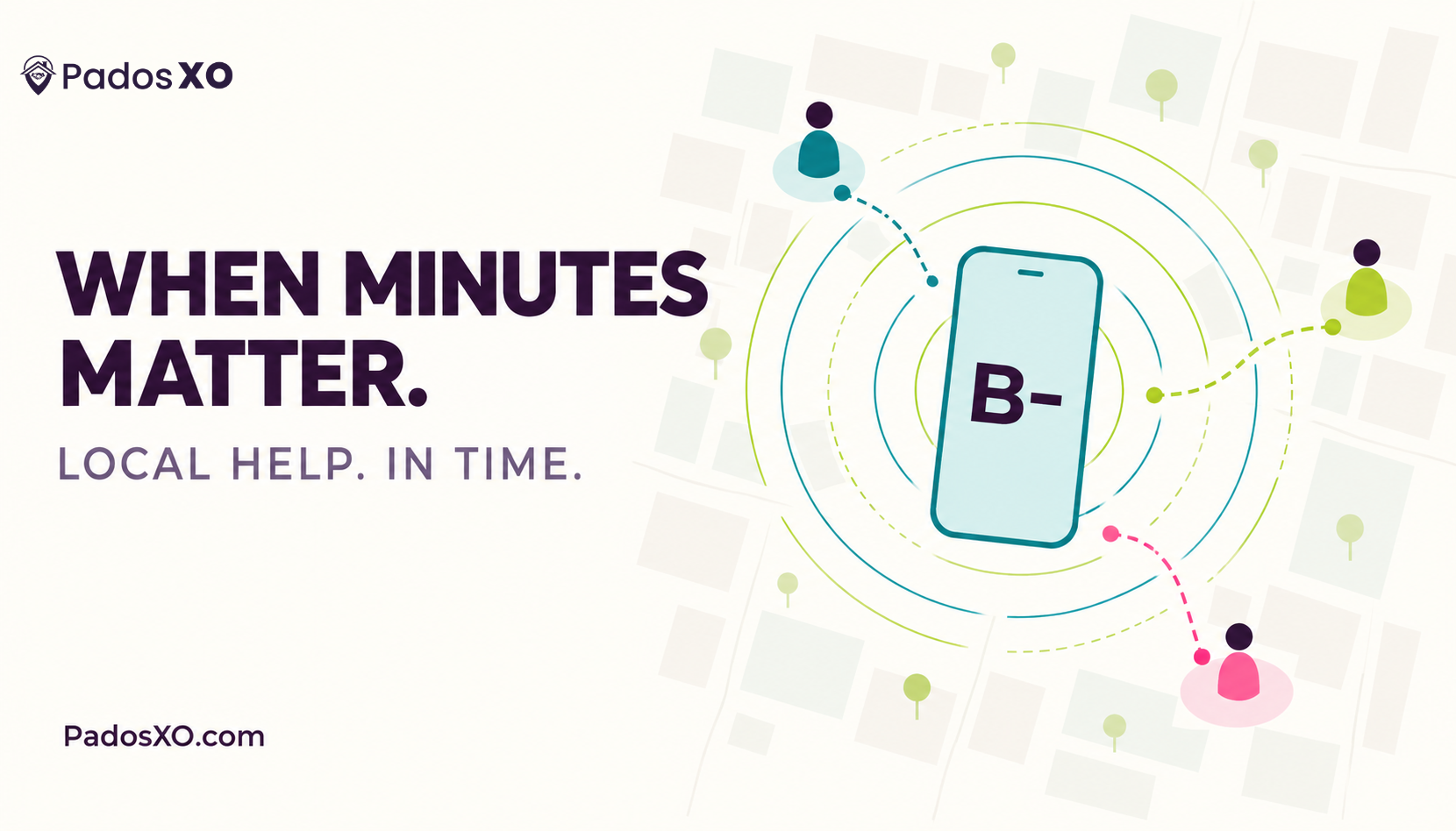
On PadosXO, an Alert goes to verified residents around you, so the people who see "B-negative needed at a hospital in Sector 62, by 10 am" are the ones who could be there by 10 am. If you're new to the app and haven't earned your Verified Local badge yet, you can post the same message as a Requirement. The How It Works page explains both. It's the gap we pointed out in every "best local apps in India" list is missing the same thing: help that's genuinely nearby. And sometimes one neighbour's help is all it takes, as in The Sunday That Changed How I Think About Cities Forever.
Need donors at a Delhi NCR hospital right now? Ask the people who can actually get there.
Post an Alert or Requirement with the blood group, hospital and deadline, and it reaches verified neighbours within a few kilometres, not strangers in other cities. And if you're a donor, say so; someone nearby will need you.
Post a blood requirement on PadosXO →
What should you do once the patient has the blood?
Close the loop, because the next family will need the same people. Thank every donor personally and tell them how the patient is doing. Note who donated and their blood group, so you know who to ask, and who not to ask for the next three months. And if the experience moved you, register as a voluntary donor yourself. The next time someone searches for blood donation near me in your area, you could be the answer.
What should you keep ready before a blood emergency?
Five minutes of preparation now saves the worst hour later. Keep these ready for every family member.
- Save e-RaktKosh on your phone.
- Know the blood group of everyone in your family, including elderly parents. Our guide on elderly parents living alone covers what else to keep on their emergency sheet.
- Keep a list of five friends willing to donate, with their groups.
- Know which nearby hospitals have their own blood bank.
Most blood emergencies are solved by a handful of people who showed up quickly. Make sure you know who yours are, and be one for someone else.
Frequently asked questions
How do I find blood urgently in Delhi NCR?
Check stock at nearby blood banks on e-RaktKosh, call the blood bank to confirm, and at the same time ask family, friends and neighbours for replacement donors with a precise message including hospital, blood group, units and deadline.
What is e-RaktKosh?
e-RaktKosh is the Health Ministry's centralised blood bank network. It lets you search blood stock availability by state, district, group and component, and find nearby blood banks and camps.
Who can donate blood in India?
Generally, healthy people aged 18–65 who weigh at least 45 kg, have adequate haemoglobin and haven't donated whole blood in the last three months. The blood centre screens every donor.
What is a replacement donor?
A replacement donor gives blood to refill a hospital blood bank's stock after units are issued to a patient. The donor's blood group doesn't need to match the patient's.
How often can I donate blood?
In India, the gap between whole-blood donations should be more than 90 days, roughly every three months.
How long does donated blood last?
Donated whole blood typically lasts 35 to 42 days, which is why blood banks need regular donations.
Can I donate blood if I have a tattoo?
Recent tattoos usually lead to a temporary deferral. The blood centre will tell you whether enough time has passed.