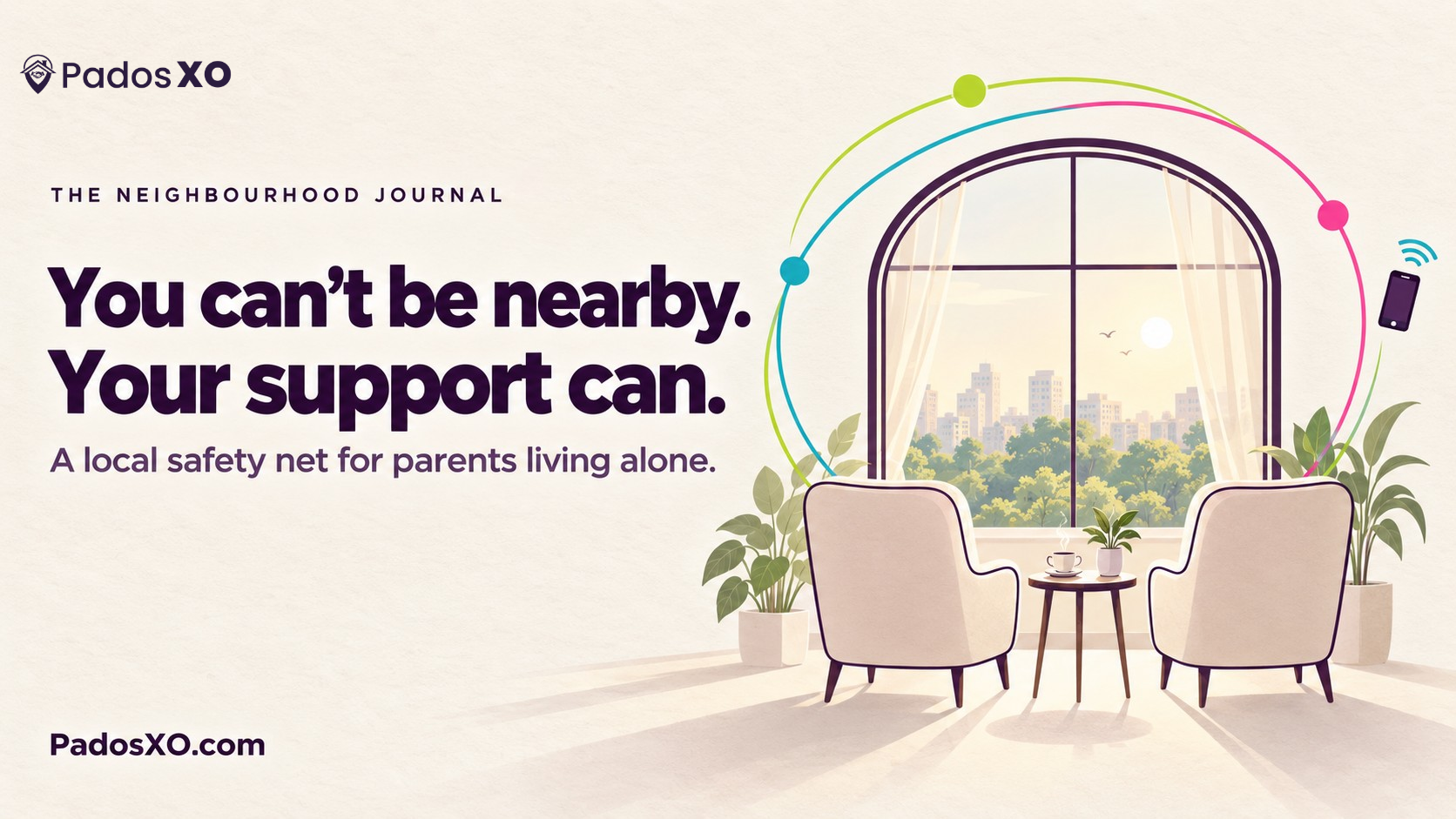
It usually hits at a random moment. You're in a meeting in Bengaluru, your mother doesn't pick up the phone twice, and for the next forty minutes you can't think about anything else. Then she calls back. She was at the chemist. Everything is fine. But the question stays: if it hadn't been fine, who would have known?
This is the reality for a very large number of families in Delhi NCR, and it's why searches for elder care services keep growing. The children moved for work. The parents didn't want to leave the home they built, the park they walk in, the friends they've known for decades. Everyone made a reasonable choice, and now there's a gap nobody planned for.
This guide is about closing that gap with practical things you can set up this month.
What are the real risks when elderly parents live alone?
Falls, sudden illness, scams and loneliness, in roughly that order of urgency. None of them are rare, and all of them are made worse by delay.
- Falls at night, in the bathroom, on the stairs. The problem is rarely the fall itself; it's lying there for hours before anyone knows.
- Sudden illness like a BP spike, a sugar crash or chest pain, where the first 30 minutes matter.
- Fraud. Retired people with savings are the main target of "digital arrest" and fake KYC calls. Our guide on digital arrest scams and the first hour is worth reading together with your parents.
- Unverified help at home. Domestic workers or attendants hired without checks.
- Loneliness. Quieter, but real. Long days without a real conversation wear people down.
Layer 1: Who lives within 100 metres?
The most important person in your parents' emergency plan is the neighbour, not the hospital. A neighbour can reach them in two minutes, open the door, call the ambulance and ride along. You can do none of that from another city.
Here's how to build this layer properly:
- Identify two or three neighbours your parents already trust, ideally one on the same floor and one who's home during the day.
- Swap numbers both ways. Your number with them, theirs saved on your parents' phone and yours.
- Spare key with the most trusted one, or a key safe the family controls.
- Tell them the basics: blood group, main medicines, the doctor's name and the hospital your parents prefer.
- Say thank you properly. Diwali sweets, a visit when you're in town. This is a relationship, not a service.
If your parents are new to the building or have lost touch with neighbours, our practical guide on how to actually meet your neighbours in an Indian high-rise is a good place to start, even for someone in their seventies.
Layer 2: Which helplines should be saved in their phone?
Save these as named contacts, with a star, and show your parents where they are.
|
Number / service |
What it's for |
Where it works |
|
112 |
Police, fire, ambulance emergency |
All India |
|
1291 |
Delhi Police Senior Citizen helpline |
Delhi |
|
14567 (Elderline) |
National helpline for senior citizens: information, guidance, emotional support |
All India |
|
1930 |
Cyber fraud, if money has been lost |
All India |
|
Family doctor + preferred hospital |
Non-emergency medical guidance, admissions |
Local |
If your parents live in Delhi, register them with the Senior Citizen Security Cell. Delhi Police says its beat staff visit registered seniors, check the physical security of the house and whether domestic help is verified, and advise them to display emergency numbers near the phone, as listed on the Delhi Police senior citizen cell page. More detail on the national Elderline is on the official Elderline website.
Layer 3: When do you need paid elder care services?
When daily tasks start slipping, not after a crisis. Watch for missed medicines, skipped meals, unpaid bills, a fall or two, or a parent who's stopped going out.
Options usually fall into four kinds:
- Part-time help: a few hours a day for cooking, cleaning, errands.
- Attendant or caregiver: daytime or live-in support for mobility and routines.
- Nursing care at home: for post-surgery recovery or chronic conditions.
- Elder care services: organisations offering check-in visits, doctor coordination and emergency response.
Whoever you hire, do the checks: ID, references from a family that used them recently, and police verification. Our Medium guide on how to find verified house help in Delhi NCR walks through the steps. Ask neighbours with parents of the same age who they use; the best caregivers almost always come by word of mouth. We made the same point about home services in the "plumber near me" problem isn't search, it's trust.
What does a good weekly routine look like?
Short, fixed and boring. Boring is good. Routines catch problems early without making parents feel monitored.
- Daily: one quick "sab theek?" message at a fixed time. If there's no reply within an hour, the plan kicks in: call, then call the neighbour.
- Weekly: a proper video call where you actually look around. Is the fridge stocked? Are the medicine strips moving?
- Monthly: check utility bills, bank SMS for odd transactions, and upcoming doctor appointments.
- Every visit home: meet the neighbours, the guard and the maid. Put faces to names.
Keep a shared note with medicines, doses, allergies, doctors, insurance details and the building's emergency contacts. Give a copy to the trusted neighbour.
How do you handle the loneliness part?
Give them reasons to be around people, not just reasons to be safe. Morning walking groups, satsang, a book club, a card game in the park, a local event for seniors. Many of these exist in every sector; they just aren't listed anywhere.
Our guide to finding running groups, book clubs and weekend meetups in your pincode works just as well for a 70-year-old looking for a morning walking circle as for a 30-year-old looking for a Sunday run. And sometimes all it takes is one stranger's kindness, as in The Sunday That Changed How I Think About Cities Forever.
Where does a neighbourhood app fit in?
It helps you find the neighbours you don't know yet. Many adult children realise they know nobody in their parents' building anymore. The friends their parents had have moved, and the new families are strangers.
On PadosXO, you or your parents can post an Ask Community question to verified residents around their home, like "Can anyone recommend a reliable physiotherapist who does home visits in Sector 50?" or "Is there a morning walking group near Shakti Khand?" The answers come from people living right there. And if something does go wrong, those are the same people who can reach the door fastest. You can read more about how it works for families on the For Residents page.
The short plan
Neighbours first, helplines second, paid help third, routine always. Set up all four this month, while everything is fine. The day you need them is not the day to start building them.
Frequently asked questions
How can I take care of my elderly parents living alone in another city?
Build a local safety net: two or three trusted neighbours with a spare key, saved helplines like 112, 1291 (Delhi) and Elderline 14567, a verified part-time helper or caregiver, and a fixed daily and weekly check-in routine.
What is the senior citizen helpline number in Delhi?
Delhi Police's senior citizen helpline is 1291. For any emergency, 112 works across India.
What is Elderline 14567?
Elderline 14567 is the national helpline for senior citizens run under the Ministry of Social Justice and Empowerment, offering information, guidance and support.
How do I register my parents with Delhi Police as senior citizens?
Delhi Police runs a Senior Citizen Security Cell with a registration process; you can also ask the local beat officer. Registered seniors may receive beat staff visits that check home security and domestic help verification.
How do I find a trusted caregiver for elderly parents in Delhi NCR?
Ask neighbours and friends with ageing parents for recommendations, check ID and references, and complete police verification before the caregiver starts.
What should elderly people living alone keep near the phone?
A list of emergency numbers, family contacts, the trusted neighbour's number, the doctor's number, blood group, main medicines and preferred hospital.
How do I protect elderly parents from phone scams?
Teach them to hang up on any call claiming to be police, CBI or a bank asking for money or OTPs, save 1930 as a contact, and make sure a trusted neighbour or family member is their first call.