
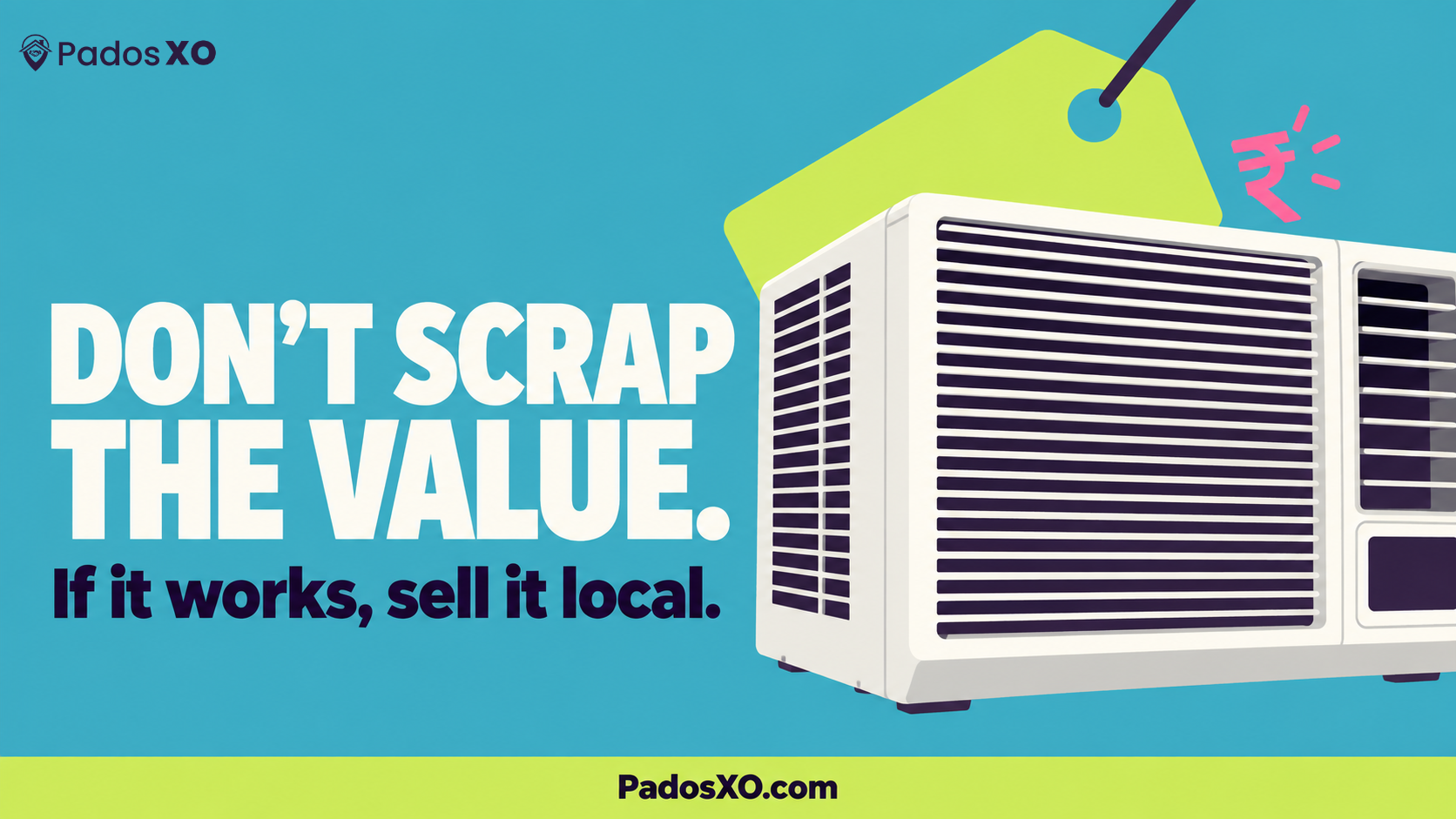
Every serious decluttering session hits the same question: is this worth calling a kabadiwala near me for, or should it just go in the bin? The honest answer depends entirely on what it is — and on whether it still works, because a working appliance sold as scrap is money left on the table. This matters more than it might seem: across a full house move or a big seasonal declutter, the gap between scrap value and resale value on just two or three working items can easily run into several thousand rupees.
How much does a kabadiwala near me pay in Delhi NCR (2026)?
Rates fluctuate daily and vary by dealer and by locality, but based on current Delhi-area scrap rate listings, this is a realistic range to expect:
|
Item |
Typical rate |
|---|---|
|
Newspaper |
₹10 – ₹12/kg |
|
Mixed plastic |
₹7 – ₹9/kg |
|
Iron |
₹23 – ₹27/kg |
|
Copper |
₹500 – ₹600/kg |
|
Aluminium |
₹140 – ₹160/kg |
|
E-waste (per piece) |
₹8 – ₹12/piece |
|
AC, 1 ton (scrap) |
₹2,800 – ₹3,200/unit |
|
AC, 1.5 ton (scrap) |
₹3,800 – ₹4,200/unit |
|
Fridge, single door (scrap) |
₹700 – ₹900/unit |
|
Fridge, double door (scrap) |
₹550 – ₹650/unit |
The mistake: selling working items as scrap
Scrap rates above assume the item is genuinely being broken down for its raw material — copper wiring, compressor metal, and so on. A 1-ton AC that still cools fine is worth far more sold as a working secondhand unit than the ₹2,800-3,200 scrap price, often several times over. The same is true of furniture, working electronics, and appliances in reasonable condition — scrap rate is the floor, not the ceiling.
How kabadiwala pricing actually works
Most kabadiwalas price by category rather than by brand or original cost — a ten-year-old premium AC and a budget AC of similar tonnage fetch roughly the same scrap price, because the value being paid for is the metal content and reusable compressor parts, not the brand. This is precisely why scrap pricing is a poor way to value anything that still functions: it deliberately ignores everything that makes a working item worth more than its raw materials, which is exactly the value a neighbour buying it secondhand is willing to pay for instead.
What's worth selling to a neighbour instead
Anything that still functions — working ACs, fridges, furniture, mobiles, even bicycles — is almost always worth listing before calling the kabadiwala. A Buy/Sell post to verified neighbours in your own pincode skips the logistics of a citywide classifieds listing (strangers, meeting-point negotiations, no accountability) and usually gets faster interest, because buying from someone in your own building or sector carries more trust than buying from a stranger on OLX or Quikr.
A simple rule of thumb before you decide
If an item still turns on, still cools, still functions as intended, ask 'would a neighbour furnishing a new flat want this' before assuming it's scrap. If the honest answer is yes, list it for a few days first — even a short window costs nothing and often surfaces a buyer, since new residents furnishing a flat are a near-constant presence in any large sector. Only fall back to the kabadiwala once that window has genuinely passed without interest, or for anything that was never going to have neighbour demand in the first place.
What genuinely should go as scrap
Broken appliances beyond repair, old newspapers and cardboard, single-use plastic and packaging, and electronics too old or damaged to have any resale value are the right call for a kabadiwala — there's no real neighbour market for these, and recycling them properly (rather than binning them) is the responsible option regardless of the small payout.
Negotiating with a kabadiwala, if you're going that route
Rates quoted over the phone or by an app are often the opening number, not the final one — weight is typically confirmed on a physical scale at pickup, and it's worth watching this happen rather than accepting a verbal estimate. For bulk scrap (a full house clearance, several appliances at once), rates are often slightly better than the standard per-kg listing since it's less effort per rupee for the dealer, so it's reasonable to ask whether a bulk rate applies before agreeing to a price for individual items separately.
Timing a sale around seasonal scrap price swings
Metal scrap rates (iron, copper, aluminium) do fluctuate with broader commodity price movements, sometimes meaningfully over a few months — while paper and plastic rates tend to move less dramatically. If there's no urgency to clear something out, it's worth checking current rates rather than assuming last year's number still applies, since a several-rupee swing per kg adds up quickly on anything sold by weight.
Finding a kabadiwala you can trust with repeat business
Most sectors have a handful of kabadiwalas who visit regularly rather than one fixed shop, which makes it hard to know who's reliable until something goes wrong — a lowballed weight or a rate that shifts after pickup. Asking neighbours who they use, rather than picking whoever happens to be doing rounds that day, is usually the fastest way to a dealer who weighs fairly and pays what was quoted, and it's a question that comes up naturally on a neighbourhood app in a way it never would with a stranger passing through.
How this plays out in real life
A Sector 137 Noida resident clearing out before a move nearly called a kabadiwala for an old but fully working 1.5-ton AC, expecting roughly ₹4,000 for scrap. A quick Buy/Sell post instead got three responses within a day from neighbours setting up a new flat, and it sold for ₹9,500 — more than double the scrap value, picked up the same evening by someone who lived two buildings away. The same move also involved genuinely broken kitchen appliances and a stack of old newspapers, which she sold to a kabadiwala the following week — getting a slightly better bulk rate than the standard per-kg listing simply by asking, since it was a full clearance rather than a single item.
Key takeaways
- 2026 Delhi NCR scrap rates: ~₹10-12/kg newspaper, ₹23-27/kg iron, ₹500-600/kg copper
- Old appliances are priced per unit, not per kg — a working 1-ton AC scraps for ~₹2,800-3,200
- A working item is almost always worth more sold secondhand than sold as scrap
- List working items to neighbours first; scrap only what's genuinely broken or unrecyclable-otherwise
- Rates vary daily and by dealer — treat these as a realistic range, not a fixed price
- Weight is confirmed on a scale at pickup — a phone-quoted rate is an opening estimate, not final
- Bulk scrap (a full clearance) can sometimes command a better rate than individual items — it's worth asking
List It Before You Scrap It
Before you call the kabadiwala, find out what it's actually worth to a neighbour. List it as a Buy/Sell post on PadosXO — it costs nothing to try, and it often pays several times the scrap rate.
FAQ
What is the kabadiwala rate for newspaper in Delhi in 2026?
Typically ₹10-12 per kg, though rates vary daily and by dealer.
How much does a kabadiwala pay for an old AC?
As scrap, roughly ₹2,800-3,200 for a 1-ton unit and ₹3,800-4,200 for 1.5-ton — but a working AC is worth significantly more sold secondhand.
What is the scrap rate for copper in Delhi NCR?
Roughly ₹500-600 per kg, among the highest-value common scrap metals.
Should I sell a working appliance as scrap or secondhand?
Secondhand almost always pays more — scrap rate reflects raw-material value only, not the appliance's working condition.
How do I sell old furniture or appliances to neighbours instead of a kabadiwala?
A Buy/Sell post to verified residents in your own pincode is usually faster and more trusted than a citywide classifieds listing.
What items should genuinely go to a kabadiwala rather than being resold?
Broken-beyond-repair appliances, old newspaper/cardboard, and electronics with no resale value — these have no real neighbour market.
Are kabadiwala rates negotiable?
Often, yes — a phone-quoted rate is usually an opening estimate, and actual weight is confirmed on a scale at pickup.
Do scrap rates change through the year?
Metal rates can fluctuate meaningfully with commodity price movements over a few months; paper and plastic rates tend to move less.
Does the brand of an appliance affect its scrap value?
Generally no — kabadiwalas price mainly by category and material content (metal, compressor parts), so brand and original cost matter far more for a secondhand sale than a scrap one.
How much can I realistically save by selling to a neighbour instead of scrapping?
Often several times the scrap value for a single working appliance — the gap between scrap and resale price is usually largest for anything still fully functional.
How do I decide whether something is worth listing before scrapping it?
Ask whether a neighbour furnishing a new flat would want it — if yes, a short listing window costs nothing and often finds a buyer before you need to fall back on scrap value.