Every household in Delhi NCR has a loft corner that grows quietly for a year. Newspapers, Amazon cartons, a dead mixer, the cooler body that "we'll repair someday". Then Diwali cleaning arrives, someone searches "kabadiwala near me", and the man who shows up names a number that feels low, weighs everything on a scale you can't read, and leaves you wondering if you just got cheated.
Sometimes you did. Often you didn't, and you just don't know what fair looks like. This guide fixes that.
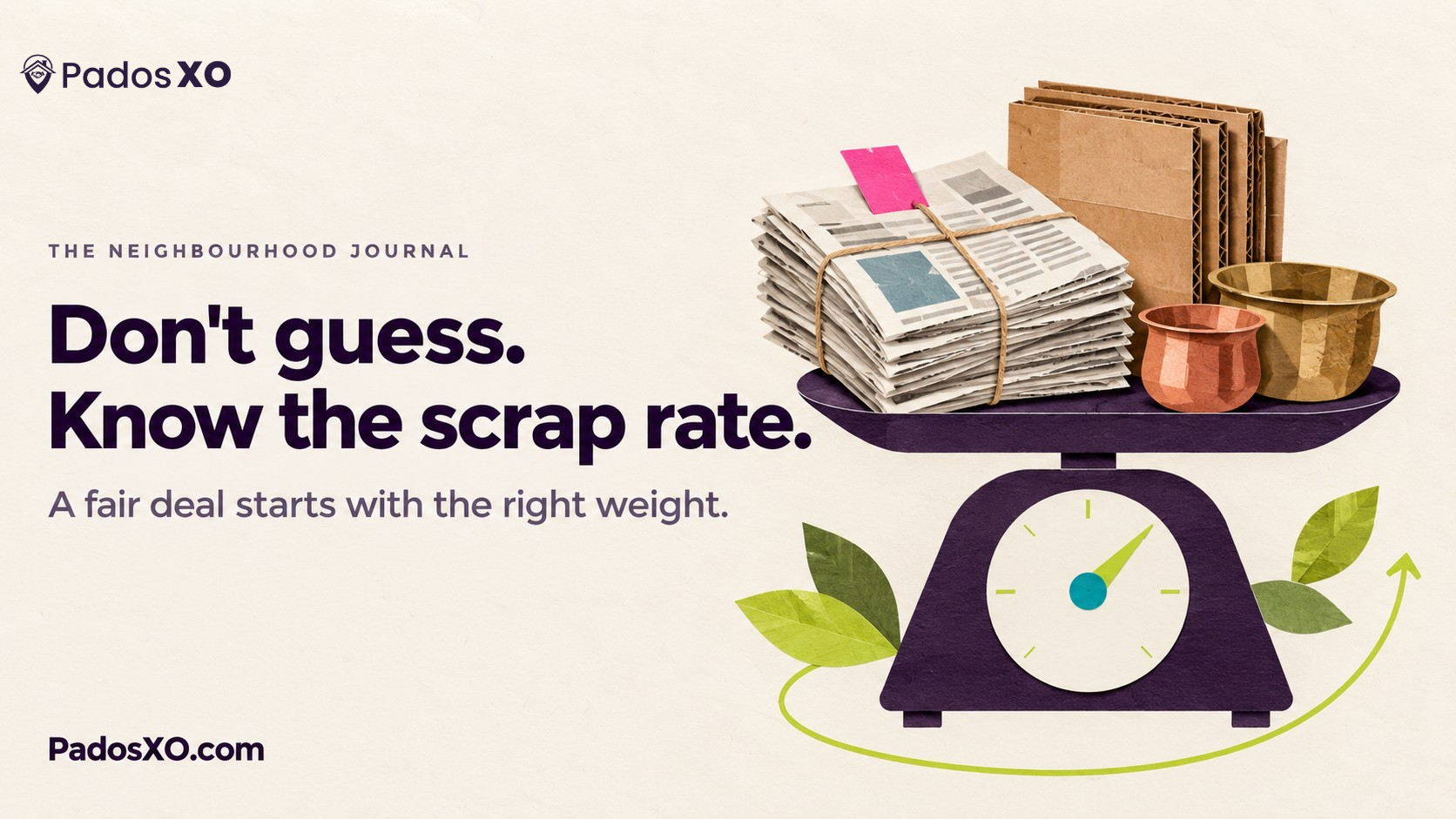
What is the scrap rate today in Delhi NCR?
Rates move every week with metal prices, but here is the realistic range for household scrap in 2026. The "market" column is the published Delhi average; the "doorstep" column is what a local kabadiwala typically pays at your gate.
|
Item |
Published Delhi rate (Aug 2026) |
Typical doorstep price |
|
Newspaper (raddi) |
~₹13.9/kg |
₹12–16/kg |
|
Cardboard / cartons |
~₹8.3/kg |
₹7–10/kg |
|
Books, notebooks, mixed paper |
varies |
₹8–14/kg |
|
Iron (loha), mixed household |
~₹33/kg |
₹25–35/kg |
|
Plastic (mixed) |
~₹14/kg |
₹8–14/kg |
|
Aluminium |
~₹162/kg |
noticeably lower at the door |
|
Brass (pital) |
~₹435/kg |
ask for per-kg quote |
|
Copper (tambaa) |
~₹645/kg |
ask for per-kg quote |
|
E-waste (general) |
~₹45/kg |
depends on item |
The published figures above come from ScrapRates' Delhi page, updated 17 August 2026. The same site notes on its newspaper rate page that doorstep quotes usually run ₹5–7 per kg below the wholesale baseline for small quantities. That gap isn't cheating. It's the kabadiwala's margin for sorting, transport and selling on.
So if someone offers ₹13 for dry newspaper in your sector, that's fair. If someone offers ₹6, that's not.
Why does your kabadiwala pay less than the "rate list"?
Because the rate list is usually the wholesale price, and your 12 kg of raddi isn't wholesale. A kabadiwala buys small lots from dozens of homes, carries them on a cycle-cart or tempo, sorts them and sells in bulk to a bigger dealer. Each step takes a cut.
Rates also drop when your material is mixed or wet. Soggy newspaper, cartons with tape and thermocol still inside, or iron with plastic attached all get discounted. That's normal pricing, not trickery.
How do you know if the weight is honest?
- Weigh it yourself before he arrives. This is the single most useful thing you can do, and most people never do it.
- Use a digital luggage scale (the hanging kind used for suitcases) and weigh bundles of newspaper before pickup. Note the number.
- Tie newspapers in bundles of roughly equal weight. It makes a short weighing obvious.
- Watch where the hook hangs on a hand-held spring scale. Ask him to hold it still at eye level.
- For a big lot, ask for weight per material separately, not one combined "sab milake" number.
A good kabadiwala won't be offended by any of this. The ones who are offended tend to be the ones you shouldn't call again.
Should you use an online kabadiwala app or the local one?
Both work. The local one is faster; the apps are more transparent on price. Here's the honest trade-off.
|
|
Local kabadiwala |
Online scrap pickup apps |
|
Speed |
Often same day, sometimes within the hour |
Scheduled slot, usually next day or two |
|
Price transparency |
Negotiated at the door |
Posted rate card, digital weighing |
|
Minimum quantity |
Takes small lots happily |
Some have a minimum weight for pickup |
|
Payment |
Cash or UPI |
Usually UPI |
|
Relationship |
Same person every month, knows your building |
Different person each time |
Many families end up using both: the local person for the monthly raddi, and an app when there's a big pile of metal or appliances after a renovation.
What about e-waste and old appliances?
Separate e-waste from general scrap and ask specifically where it goes. Old phones, chargers, routers, laptops and small appliances contain metals worth recovering, but also parts that shouldn't be burned or dumped.
Look for pickups that hand e-waste to authorised recyclers, or drop it at a brand's collection point. For big appliances like fridges, ACs and washing machines, get a per-item quote, not a per-kg one, because the compressor and copper inside change the value.
And before you sell a working appliance for scrap, ask your neighbours. A working cooler sold as scrap fetches a few hundred rupees; the same cooler sold to a student two towers away fetches a few thousand and stays out of the landfill. We wrote about this exact gap in Your Building Has 200 Families.
How do you find an honest kabadiwala near you?
Ask the people on your floor who they've used for years. The best kabadiwala in any society is the one three families have already trusted with their loft, their building's keys and their monthly raddi for a long time.
- A few signs you've found a good one:
- He quotes the per-kg rate before weighing, not after.
- He's fine with you weighing first.
- He comes back on the promised day for the big items.
- Your neighbours recommend him without hesitation.
This is where a neighbourhood recommendation beats a search result. Your society's delivery guys and guards usually know him too; as we wrote in The Delivery Guy Who Knows Your Neighbourhood Better Than You Do, the people who walk your lanes daily hold a lot of this local knowledge.
Scrap or sell? A quick decision rule
If it still works, sell or give it locally. If it doesn't, scrap it. Furniture, bikes, study tables, cribs and working electronics are worth far more to a neighbour than to a scrap dealer. If you'd rather list it yourself, PadosXO for residents explains how Buy/Sell posts reach people nearby. Our guide to OLX alternatives for buying and selling locally covers the safest ways to do that, and our Medium essay on the rise of the hyperlocal marketplace explains why "near me" selling is quietly replacing citywide classifieds. On LinkedIn, we also unpacked why "hyperlocal" gets 2,400 searches a month and what it really means.
Clearing the loft before Diwali? Your neighbours might pay more than the kabadiwala.
List the working stuff as a Buy/Sell post for people nearby, and post a quick Requirement for "trusted kabadiwala this Saturday" to get names your neighbours actually vouch for.
Post your Buy/Sell on PadosXO →
What should you do before the kabadiwala arrives?
Sort, weigh, and know the rate before he rings the bell. Ten minutes of prep is what separates a fair deal from a rushed one.
- Sort into paper, cardboard, iron, other metal, plastic, and e-waste.
- Keep paper and cartons dry, and remove tape and thermocol.
- Weigh bundles on your own scale and note the numbers.
- Keep working items aside to sell or donate.
- Agree the per-kg rate for each material before weighing starts.
- Take UPI if you want a record of the payment.
Do this once and you'll never again feel unsure after a scrap sale. You'll also know exactly whose number to save.
Is it worth calling a kabadiwala for a small pile?
Yes, if you combine it with a neighbour's pile. Most local kabadiwalas will happily come for 10–15 kg, but the rate and their willingness to come quickly improve when there's more to collect in one stop. Two or three flats on the same floor clearing out together on the same Sunday morning is the easiest win in this whole guide. It also means one person watches the weighing for everyone.
Frequently asked questions
What is the raddi rate per kg in Delhi today?
In 2026, dry newspaper typically fetches about ₹12–16 per kg at the doorstep in Delhi NCR. Published Delhi averages were around ₹13.9 per kg in August 2026.
What is the scrap rate of iron per kg in Delhi?
Mixed household iron was quoted around ₹33 per kg in Delhi in August 2026. At the doorstep, expect roughly ₹25–35 per kg depending on grade, rust and quantity.
Why do kabadiwalas pay less than online rate lists?
Online rate lists often show wholesale prices. Kabadiwalas buy small quantities, sort and transport them, so doorstep prices are usually a few rupees per kg lower.
How can I check if my kabadiwala is cheating on weight?
Weigh bundles yourself with a digital luggage scale before pickup, agree per-kg rates before weighing, and ask for material-wise weights instead of one combined figure.
Where should I dispose of e-waste in Delhi NCR?
Keep e-waste separate from general scrap and give it to pickups that hand it to authorised recyclers, or use brand collection points. Ask for per-item quotes on large appliances.
Is it better to sell old furniture or give it to a kabadiwala?
If it still works, selling or giving it to someone nearby almost always gets more value than scrap. Scrap only what's genuinely broken.
How do I find a trusted kabadiwala near me?
Ask neighbours who have used the same person for years, check that he quotes rates before weighing, and prefer people your building's guards and staff already know.