An RWA app gets recommended constantly as "the fix" for a chaotic society WhatsApp group, and that advice is half right — it solves one real problem while leaving the other one completely untouched.
This piece looks at why WhatsApp groups break down in the first place, what a proper RWA app genuinely fixes, and what still needs a different kind of tool entirely.
Why this happens in nearly every society, not just yours
If your building's WhatsApp group feels unmanageable, that's not a reflection of your specific neighbours being unusually difficult — it's a structural problem repeating across essentially every Indian housing society that's tried to run community life through a chat app. WhatsApp groups have no threading, no way to separate an urgent water-outage notice from a chain forward about fake news, no search that actually works once a group has thousands of messages, and no way to reach one specific neighbour without either a broadcast to everyone or hunting for their individual number. A tool built for a friend group of fifteen simply wasn't designed for a resident base of two hundred flats. Dhruv Paliwal explains exactly why the 500-member RWA group stopped working, on LinkedIn, in WhatsApp Groups Broke Neighbourhood Communication. Here's What We're Building Instead..
The specific failure patterns
A few chaos patterns show up almost everywhere. The forward problem: unrelated festival greetings, health misinformation and political content crowd out the one genuinely important notice about a water outage. The notice-burial problem: an urgent maintenance announcement posted at 11am is already three hundred messages down by 6pm, effectively invisible to anyone who didn't happen to be online at the right moment. The unpopular-opinion problem: any disagreement about society rules or a committee decision spirals into a public, screenshot-able argument that a smaller, more structured conversation would have handled far better. And the silent-majority problem: a handful of the most active posters dominate the group's tone, while most residents mute it entirely and miss everything, including what actually mattered.
Why muting the group doesn't actually solve anything
Muting is the most common coping response, and it's completely understandable — but it trades one problem for a worse one. A muted group still occasionally contains a genuinely important notice (a security alert, a water-supply change, an emergency), and muting means you now reliably miss those too, not just the noise. You've solved the annoyance and reintroduced the original problem the group was supposed to solve: staying informed about your own building. This is the core mismatch — the group is too noisy to leave unmuted, but too occasionally important to mute safely, and WhatsApp's flat, unstructured format offers no middle ground.
What an RWA app fixes — and what it doesn't
A dedicated RWA app (MyGate, NoBrokerHood, ApnaComplex and similar) fixes part of this: official notices go through a structured, trackable channel rather than getting lost in chat, and maintenance-related communication is separated from casual conversation. What an RWA app doesn't fix is the social side — it's built for administration, not for asking which nearby paediatrician is good, finding a trustworthy plumber, or simply getting to know the neighbours two floors down. Adopting an RWA app solves the notice-burial problem; it doesn't solve the reason the WhatsApp group existed socially in the first place. The longer essay version of the same argument, with more of the backstory, is on Medium: The Quiet Death of the RWA WhatsApp Group.
What genuinely helps: separating the two jobs
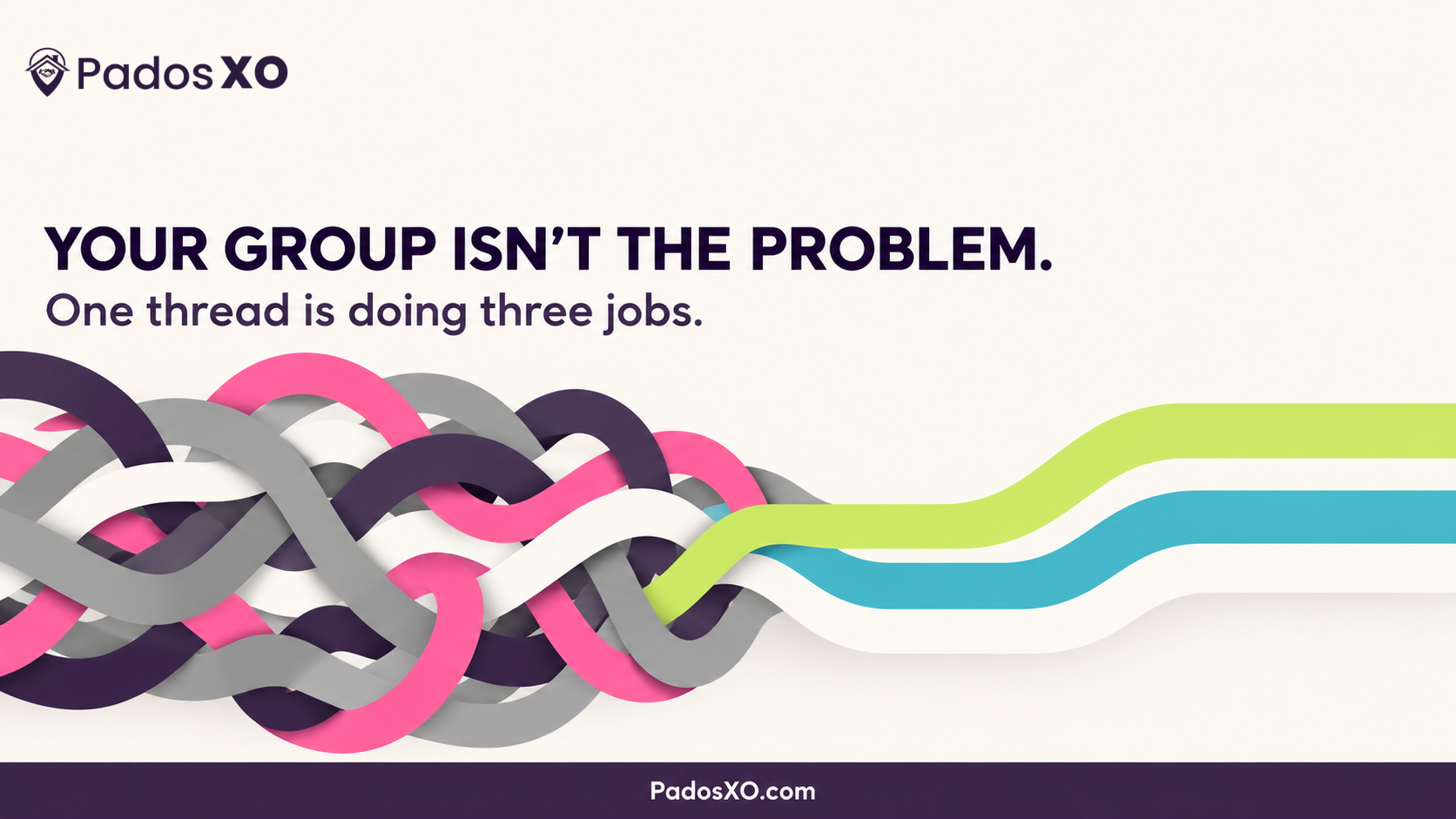
The most workable fix most societies land on isn't finding one app to replace WhatsApp entirely — it's accepting that “society communication” is actually two different jobs that got jammed into one chat thread. Official, urgent notices belong in a structured channel (an RWA app or a formal notice board), where they're findable and don't compete with casual chatter. Informal, social, recommendation-seeking conversation — the “does anyone know a good electrician” or “anyone else notice the lift acting up” kind of message — belongs somewhere built for exactly that kind of exchange, ideally one that reaches beyond just your building's group to the wider sector where a better answer might actually be waiting. A verified neighbourhood app like PadosXO is built specifically for that second job, which is the half of the problem an RWA app was never trying to solve.
A realistic way to actually change this in your own society
Wholesale replacing an established WhatsApp group is hard — people resist migrating, and a half-adopted alternative is worse than a chaotic-but-universal one. A more realistic path: keep the WhatsApp group for genuinely urgent, time-sensitive broadcasts only, formally request the committee route routine notices through a proper RWA app if the society doesn't already have one, and separately, individually, start using a neighbourhood app for the social and recommendation side of things — this doesn't require society-wide buy-in at all, since you join as an individual resident regardless of what your building collectively does. Change often starts with a handful of residents quietly using a better tool for the social layer, not a formal committee vote to abandon WhatsApp entirely. The governance side of the chaos a broken WhatsApp group usually reflects is covered in our guide to housing society committee rules.
What this looks like once it's actually working
Societies that have genuinely sorted this out tend to describe a fairly consistent end state: the WhatsApp group goes quiet except for real emergencies and is, ironically, far more useful once it's not competing with two hundred unrelated messages a day. Routine notices — maintenance due dates, scheduled water outages, upcoming AGMs — live in a structured RWA app where residents can actually find them again later. And the social layer — who's a good physio, whether anyone's selling a barely-used cot, what that noise from the next building was — happens somewhere built for exactly that, reaching beyond just one building's group to the people in the wider sector who might have the answer a single building's WhatsApp group never could.
Why this is worth fixing, not just tolerating
It's tempting to treat a chaotic society group as a minor, unavoidable annoyance of urban living — something everyone just complains about and lives with. But the cost is real: genuinely important notices get missed, minor disagreements escalate into lasting neighbour friction that a better format would have defused, and the constant low-grade noise trains people to disengage entirely from their own community's communication, which defeats the original purpose of having a group at all. Fixing the structure — not the people in it — usually resolves most of what feels like a purely social problem.
A Better Way to Stay Connected
Tired of missing real notices in a chaotic WhatsApp group? For the social side of neighbourhood life — recommendations, local marketplace, actually meeting nearby neighbours — download PadosXO free on the Play Store.
Frequently asked questions
Why is my RWA WhatsApp group so chaotic?
WhatsApp groups aren't built for large, loosely connected communities — there's no threading, weak search, and no way to separate urgent notices from casual chat and forwards, which is why nearly every large society group eventually becomes overwhelming regardless of who's in it.
What is a good alternative to a society WhatsApp group?
Most societies benefit from splitting the job: an RWA app (MyGate, NoBrokerHood, ApnaComplex) for structured official notices and billing, and a neighbourhood app like PadosXO for the social side — recommendations, local marketplace and actually connecting with nearby neighbours.
Should I mute my society WhatsApp group?
Muting reduces noise but means you'll also miss genuinely important, time-sensitive notices buried in the same thread — it manages the symptom without fixing the underlying problem. Routing official notices through a structured RWA app while muting the informal chat is a better middle ground.
What is an RWA app used for?
An RWA (Resident Welfare Association) app handles the administrative side of society life — maintenance billing, visitor and gate management, and structured notices — solving the notice-burial problem a chaotic WhatsApp group creates, though not the social or recommendation side.
How do I get my society to stop relying only on WhatsApp?
Full replacement is hard to coordinate — a more realistic approach is proposing an RWA app for official notices at the next AGM, while individually adopting a neighbourhood app for social connection, which doesn't require society-wide agreement since you join it yourself.
Is it normal for society WhatsApp groups to have arguments and drama?
Yes, unfortunately — it's an extremely common pattern once a group grows past a certain size, largely because WhatsApp's public, unstructured format turns minor disagreements into visible, screenshot-able arguments far more easily than a more structured conversation format would.
Can a neighbourhood app actually replace my society's WhatsApp group?
Not entirely, and it doesn't need to — a neighbourhood app like PadosXO is best used alongside a WhatsApp group for urgent broadcasts and an RWA app for official notices, specifically covering the social and recommendation-seeking side that neither of the other two was built for.
Why do forwards and spam take over society WhatsApp groups so easily?
With no moderation tools, no threading and no way to separate topics, a single unrelated forward gets equal visibility to an urgent notice — there's no structural way for a group admin to keep off-topic content contained without simply removing members, which most admins are reluctant to do.
What are the best alternatives to WhatsApp groups for a housing society?
The realistic answer is two tools, not one: an RWA community app for official notices, billing and gate management, and a neighbourhood app for the informal, recommendation-seeking side WhatsApp was never structured for. Looking for a single app to replace WhatsApp entirely is usually why the search for alternatives to WhatsApp groups stalls.