
How are society maintenance charges calculated in India?
There are two common methods. The first is per square foot: a flat rate (say, ₹3–4 per sq ft) multiplied by your flat's area, so a larger flat pays more. The second is equal per flat: every home pays the same amount regardless of size, on the logic that everyone uses the lift, guards and gate equally. Some societies use a hybrid equal charges for shared services, per-sq-ft for a sinking fund. Which one applies to you is defined in your society's registered bye-laws, not by whoever is loudest at the meeting.
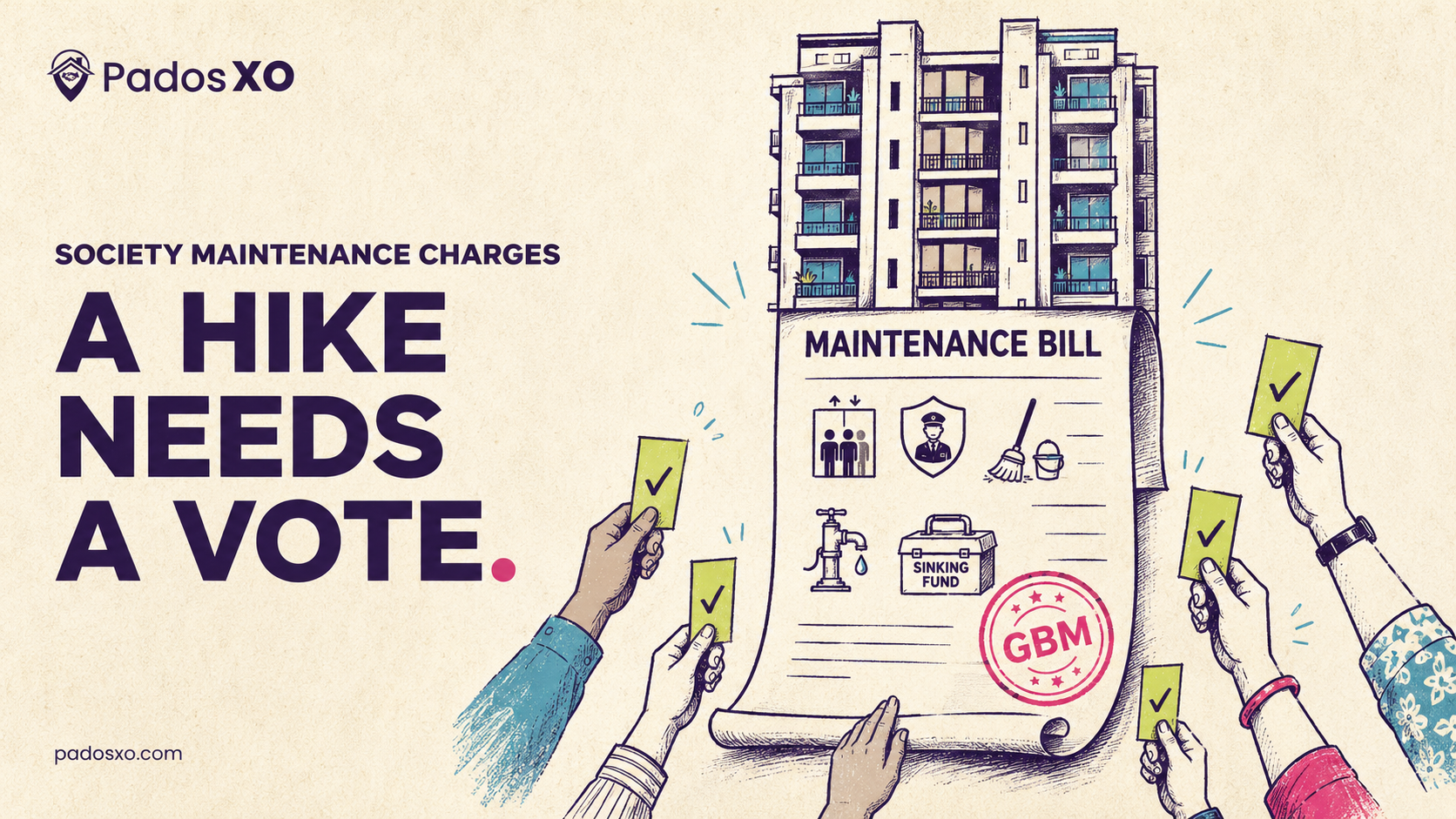
Maintenance typically covers security, common-area electricity and cleaning, lift upkeep, water pumping, minor repairs and a contribution to the sinking fund for big future works. Property tax and your own electricity and water usage are usually separate.
Can a society increase maintenance charges without a vote?
As a rule, no. A revision to maintenance charges is a decision for the general body of members, passed at a general body meeting (GBM) with proper notice, not something a managing committee — or a handful of active members in a group chat — can impose unilaterally. The precise threshold and notice period come from your society's bye-laws and the Cooperative Societies rules of your state. If a hike appears with no meeting, no agenda and no minutes, residents are within their rights to ask for the resolution that authorised it.
What happens if you don't pay maintenance?
Non-payment usually triggers a defined sequence: a reminder, then interest on the overdue amount at the rate your bye-laws specify, then a formal notice, and ultimately recovery proceedings. Societies can restrict access to certain non-essential common amenities, but in many states they cannot cut off essential services like water in a way that's been challenged in court. If you're withholding payment because you dispute a charge, don't just go silent — put your objection in writing and raise it at the GBM, so there's a record of a genuine dispute rather than a simple default. Maintenance charges and committee eligibility sit under the same Cooperative Societies Act — see our guide to housing society committee rules.
Do bigger flats pay more?
Only if your society uses the per-square-foot method — then yes, a 3BHK pays more than a 2BHK. Under the equal-per-flat method, they pay the same. This is one of the most common sources of friction in Indian societies, and it's worth knowing which method your bye-laws actually prescribe before you argue about the bill.
When a charge is genuinely unfair — and what to do
Sometimes a hike is legitimate: costs rise, a lift needs replacing, the sinking fund is thin. Sometimes it isn't — a charge pushed through without a vote, or one that quietly benefits a few. Either way, the answer is the same. Read the notice and the bye-laws. Talk to your neighbours to see whether the concern is shared. Then raise it formally at the general body meeting, where decisions can actually be made or reversed, rather than letting it simmer in the group chat.
That last step is where most residents get stuck, because coordinating neighbours over WhatsApp is chaos. On PadosXO you can post to verified neighbours in your own society and pincode through an Ask Community post — “Has anyone else seen the 30% maintenance hike? Should we raise it at the next GBM?” — and gather a genuine, verified consensus before the meeting instead of a thread of forwards. This kind of society governance conversation is exactly what happens on PadosXO's For Residents section.
How this plays out in real life
A Sector 76 society in Noida announced a 30% maintenance increase over a single WhatsApp poll one afternoon, citing rising guard costs. A resident asked the obvious question — where was the GBM resolution? — and found there wasn't one. Instead of fighting it alone, she gathered verified neighbours, confirmed the concern was widespread, and the committee was asked to table the increase properly at a general body meeting with actual figures. The revised hike that passed was 12%, backed by an audited cost sheet everyone could see. The charge went up; the difference was that it went up legitimately.
How to calculate your society maintenance charges
Understanding the society maintenance charges rules starts with the calculation itself. If your society uses the per-square-foot method, the maintenance charges calculation is straightforward: multiply the rate per square foot by your flat's built-up area. So at ₹3.50 per sq ft, a 1,200 sq ft flat pays ₹4,200 a month, while a 1,800 sq ft flat pays ₹6,300. Under the equal-per-flat method, both would pay the same amount regardless of size. Knowing which method your society's bye-laws prescribe is the single most useful thing you can do before questioning a bill — most disputes come down to residents assuming the wrong method.
It also helps to know what the money funds. A typical maintenance charge bundles security and housekeeping salaries, common-area electricity and water, lift maintenance, generator upkeep, and a monthly contribution to the sinking fund — the reserve every society is expected to build for major future repairs like lift replacement or facade work. When a hike is proposed, ask which of these line items actually rose. Dhruv Paliwal writes about accountable local governance on LinkedIn: What Makes a Neighbourhood Space Actually Trustworthy.
Key takeaways
Per-sq-ft: rate × your flat's area. Equal method: same for every flat
Charges typically cover security, cleaning, lifts, common utilities and the sinking fund
A revision needs general-body approval, not a WhatsApp poll
Check your society's registered bye-laws for the exact method and thresholds
What to do if you think your maintenance bill is wrong
If a maintenance hike lands in your inbox and the math doesn't add up, the right first step isn't a WhatsApp group vent — it's a written request to the managing committee for the last two years of audited accounts, which every member has a right to see under most state cooperative society acts. Compare the disputed line item (security, housekeeping, a sudden repair fund contribution) against what it cost the previous year. A genuine cost increase should be explainable with an invoice; an unexplained jump is worth raising formally at the next general body meeting, where it has to be discussed on record rather than settled informally by the committee alone.
RWA app vs manual maintenance collection
A growing number of societies now collect maintenance through an RWA app rather than cash or bank transfer with a register — it timestamps every payment, auto-generates receipts, and removes the most common source of “I paid, it's not showing” disputes. If your society still manages this manually, raising the idea of a proper RWA app at the next AGM is one of the highest-value, lowest-controversy suggestions a resident can make; it protects the treasurer as much as the residents, since a manual cash register is where genuine, well-meaning committees end up facing avoidable accusations.
Key takeaways
You have a right to see audited society accounts — request them in writing if a hike looks unexplained
Genuine cost increases should be traceable to an actual invoice, not just announced
An RWA app removes most “did I pay” disputes by timestamping every maintenance payment
Raise billing concerns formally at the general body meeting, on record, not only in the WhatsApp group
⚠ ACCURACY NOTE
Society law is governed by state Cooperative Societies rules and your own registered bye-laws, which vary. Treat this as a practical overview, not legal advice, and check your society's bye-laws for the exact figures and thresholds. To compare notes with people in your actual society, post to your verified neighbours on PadosXO — download it free on the Play Store.
Frequently asked questions
How are society maintenance charges calculated in India?
Usually either per square foot of your flat (larger flats pay more) or equally per flat, as defined by your society's registered bye-laws and approved by the general body. Charges typically cover security, cleaning, lifts, common electricity and the sinking fund.
Can a society increase maintenance charges without a vote?
Generally no. A revision must be approved by the general body at a properly noticed meeting, per your bye-laws and state Cooperative Societies rules. If a hike appears with no meeting or minutes, residents can ask for the authorising resolution.
What happens if you don't pay society maintenance?
Expect a reminder, then interest on the overdue amount, a formal notice and eventually recovery proceedings. If you're disputing a charge, object in writing and raise it at the GBM rather than silently withholding payment.
Do larger flats pay more maintenance?
Only under the per-square-foot method. If your society charges equally per flat, all flats pay the same regardless of size. Check which method your bye-laws prescribe.
Can a society increase maintenance charges without a meeting?
Generally no — a maintenance revision is expected to be approved by the general body at a properly noticed meeting, not decided unilaterally by the managing committee or announced informally. Check your specific society's registered bye-laws for the exact procedure.
What is an RWA app used for?
An RWA (Resident Welfare Association) app is typically used for maintenance billing and payment tracking, visitor and delivery management, complaint logging and notices — the administrative side of running a society. It's different from a neighbourhood app like PadosXO, which connects you socially to verified people across your wider area, not just your own complex.