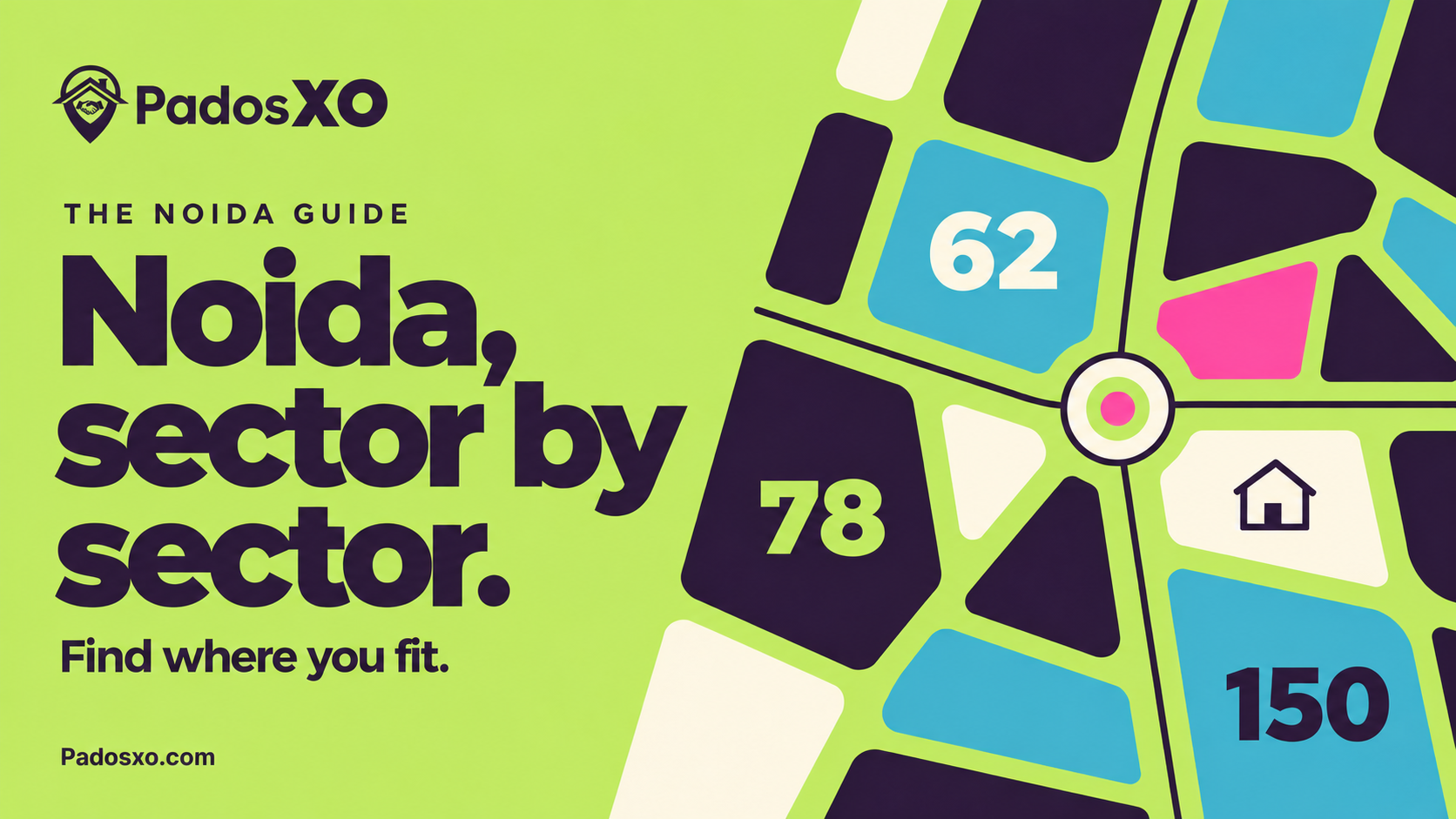
Sectors in Noida number well past a hundred, and that sheer volume is exactly why most guides to the city either oversimplify into three vague zones or dump an unsorted list that helps nobody actually decide.
This guide groups every meaningful cluster of Noida's sectors by who they genuinely suit — commute priority, family needs, or budget — so you can narrow from over a hundred numbers down to two or three worth an actual visit.
Why Noida uses numbers, not names
Unlike Delhi's named colonies or Gurgaon's phase-and-sector hybrid system, Noida was planned almost entirely around a numbered sector grid from the outset, administered by the Noida Authority. This makes Noida unusually easy to navigate once you understand the broad geography — lower numbers generally sit closer to the Delhi border and the Noida-Greater Noida Expressway's starting point, while higher numbers extend outward toward Greater Noida. It also means a newcomer's first genuinely useful question isn't “what's this area called” but “which sector, and what's it known for” — which is exactly what this guide organises by. See what's live in every Noida sector this guide maps, on PadosXO's Noida page.
Noida's sectors, grouped by who they actually suit
|
Group |
Representative sectors |
Best for |
|
IT / Expressway corridor |
Sector 62, Sector 132, Sector 135, Sector 136, Sector 137 |
Corporate & startup professionals wanting a short commute |
|
Established family sectors |
Sector 50, Sector 51, Sector 61, Sector 78 |
Families wanting settled infrastructure, schools and parks |
|
Green / lower-density family |
Sector 150, Sector 168 |
Families prioritising space and sports facilities |
|
Central / older Noida |
Sector 18, Sector 15, Sector 16, Sector 27 |
Value-seekers wanting central access at moderate rent |
|
Budget / value belt |
Noida Extension (Greater Noida West) sectors |
Budget-first renters and buyers wanting maximum space per rupee |
The IT and Expressway corridor
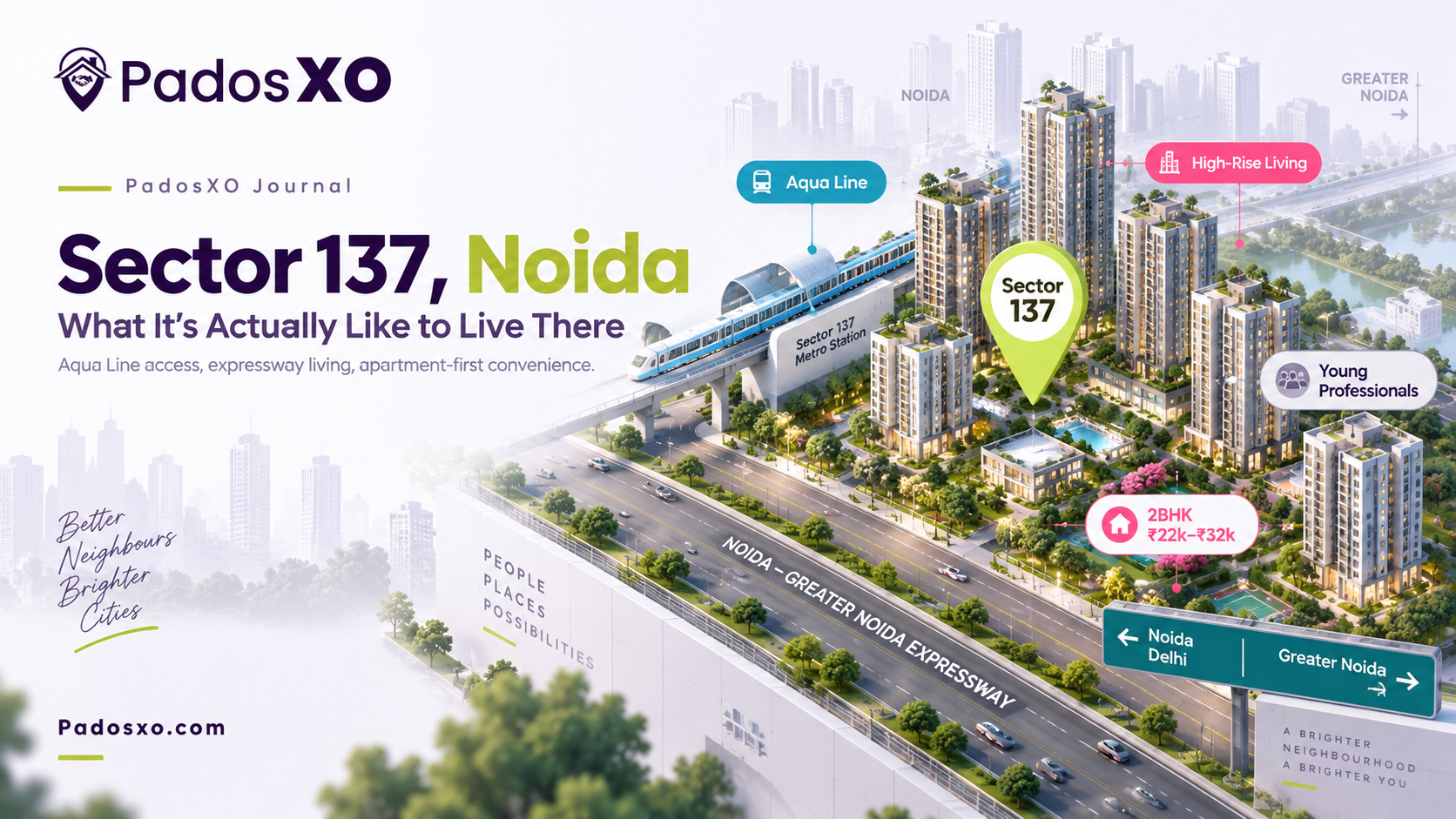
Sectors 62, 132 and the cluster around 135-137 form Noida's densest concentration of IT parks, startups and corporate offices, and the residential sectors serving them — chiefly 137 itself — have grown accordingly. If your work is based anywhere along this corridor, living within it is almost always worth the density trade-off, since the alternative is a daily commute that eats disproportionately into your week. Sector 62 in particular has the advantage of being both an employment hub and a residential option simultaneously, letting some residents genuinely walk to work.
The established family sectors
Sectors 50, 51, 61 and 78 represent Noida's more settled, mid-city residential core — developed earlier than the Expressway-facing sectors, with schools, markets and parks that have had years to mature rather than being newly built alongside the housing. Families relocating to Noida without a specific commute constraint pulling them toward the Expressway corridor often gravitate here, trading a slightly longer drive to the newest IT parks for a more established, walkable daily life.
The green, lower-density family sectors
Sector 150 stands out specifically for its large green belt and sports city development, and Sector 168 offers a broadly similar, less-searched alternative with a comparable lower-density feel. Both suit families and anyone specifically prioritising open space and a calmer environment over minimising commute time — see our dedicated Sector 137 vs Sector 150 comparison for the detailed trade-off against Noida's IT corridor sectors. The one Noida sector that gets its own dedicated deep dive is covered in our Noida Extension guide.
Central and older Noida
Sectors 15 through 18 and nearby represent some of Noida's oldest developed areas — genuinely central, well served by the original metro line, and generally more affordable than the newer Expressway-facing sectors precisely because the housing stock is older. This belt suits renters and buyers who want central access without paying a premium for brand-new construction, and who don't mind slightly older buildings in exchange for an established, walkable neighbourhood.
The budget value belt
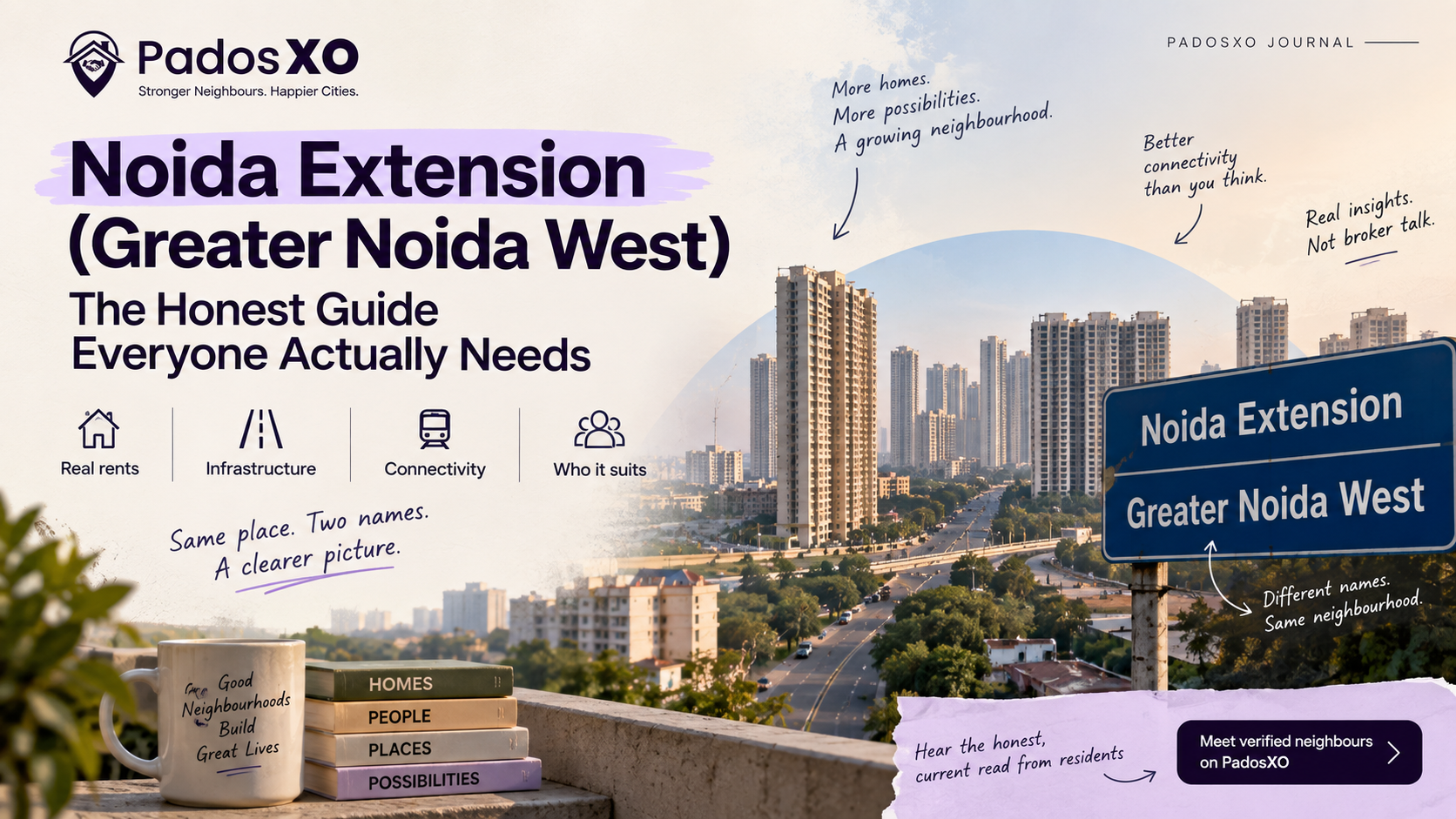
Noida Extension, formally Greater Noida West, sits apart from the numbered-sector core in both geography and character — see our dedicated guide for the full picture. In short: it's the value frontier of the Noida belt, offering meaningfully more space per rupee at the cost of a longer commute and less mature metro coverage, and it deserves to be evaluated on its own terms rather than folded into a general “Noida” verdict.
How to actually choose, once you know the groups
Start with your non-negotiable — commute corridor, budget ceiling, or space requirement — and let that narrow you to one of the five groups above before you start comparing individual sectors within it. Trying to compare a Sector 137 apartment against a Sector 78 independent floor directly, without first deciding whether commute or space matters more to you, is how most newcomers end up overwhelmed by Noida's sheer number of options. Once you're down to two or three specific sectors, that's exactly the point at which talking to verified residents already living there — rather than reading another ranked listicle — gives you the most useful, current information. For the newcomer's version of this same map, start with our sector-by-sector guide for new residents.
Noida's sector numbering: a rough mental map
As a general orientation (not a precise rule, since Noida's development didn't proceed in a perfectly linear sequence), sectors in the teens and twenties sit closest to the Delhi border and among the oldest developed; the thirties through sixties span a mix of institutional, industrial and established residential zones; the seventies through nineties cover more established mid-city residential sectors; and sector numbers above 100 generally indicate newer development, including the Expressway corridor and the sectors nearest Greater Noida. This isn't precise enough to replace checking a specific sector directly, but it's a genuinely useful first filter when a sector number alone is all the information you have.
Sectors families ask about most, beyond the obvious picks
Beyond Sector 150 and the established 50/78 belt, a few other family-oriented sectors come up often in local conversation without getting the same search volume: Sector 61, immediately next to 62's employment hub, offers family housing within genuine walking distance of a major job centre — an underrated combination. Sector 76 and Sector 77, part of a newer, more planned residential push, are increasingly popular for their wider roads and newer school infrastructure, at rents that still sit below the Expressway-corridor premium. None of these get the search volume of Sector 137 or 150, but they're worth a direct look for anyone whose priorities don't map neatly onto the most-searched names.
Common mistakes newcomers make when picking a Noida sector
- Choosing based on sector number alone, assuming lower always means better or more central
- Comparing rent without factoring in metro or Expressway proximity, which materially affects real commute cost
- Assuming all of Noida Extension is equally developed, when quality varies significantly street to street
- Skipping a direct evening visit, and judging a sector only from a daytime broker tour
- Not asking current residents about DG backup charges and water reliability, which vary more than rent listings suggest
Ask Residents Before You Decide
Narrowed down to a shortlist of Noida sectors? Get the honest, current read from verified residents in each before you decide. Download PadosXO free on the Play Store and connect with real neighbours across Noida.
Frequently asked questions
How many sectors does Noida have?
Noida's numbered sectors run roughly from Sector 1 to Sector 168, though not every number in that range is currently developed or residential — some are reserved for industrial, institutional or future use.
What is the best sector to live in Noida?
There's no single best sector — it depends on your priority. Sector 137 suits Expressway commuters; Sector 150 suits families wanting green space; the Sector 50/78 belt suits families wanting established infrastructure; and Noida Extension suits budget-first renters and buyers.
Which Noida sectors are best for IT professionals?
Sectors along the Noida-Greater Noida Expressway corridor — particularly 62, 132 and 137 — are best for IT and startup professionals given their proximity to Noida's major tech parks and offices.
Are lower-numbered sectors in Noida better than higher-numbered ones?
Not necessarily — lower numbers tend to be older and more central, while higher numbers include both newer, well-planned developments (like 150) and the more distant Extension belt. Sector number alone isn't a reliable quality signal; what the sector is actually known for matters more.
Is Noida better organised than Gurgaon for a newcomer?
Many newcomers find Noida's straightforward numbered-sector grid easier to navigate initially than Gurgaon's mix of named phases, sectors and colonies, though both cities reward research into the specific locality over relying on the naming system alone.
What's the difference between Noida and Greater Noida?
Noida and Greater Noida are administered by different development authorities and are geographically distinct, though they're connected by the Noida-Greater Noida Expressway and often discussed together as one extended corridor.
Which Noida sector has the best metro connectivity?
Sectors along the Aqua Line and the older Blue Line — including 137, 62, 51 and the central Sector 15-18 belt — offer the strongest metro access; Noida Extension currently has comparatively less comprehensive coverage.
Is Sector 61 or Sector 76 in Noida worth considering over the more popular sectors?
Yes, for the right priorities — Sector 61 offers family housing close to the Sector 62 employment hub, and Sectors 76-77 offer newer, well-planned residential infrastructure at rents below the Expressway-corridor premium. Both are worth a direct look even though they get less search attention than Sector 137 or 150.
How do I decide between two Noida sectors that seem similar on paper?
Visit both at the time of day you'd actually be commuting, compare actual maintenance and DG backup charges rather than just rent, and talk to current residents in each — a neighbourhood app like PadosXO makes that last step possible before you've even moved in.