Noida Extension carries a reputation that's several years out of date for a lot of people still searching it — the delayed-possession, half-built image many carry around simply isn't the accurate picture for most of the belt anymore.
This guide is an honest, current look at what Noida Extension actually offers in 2026, what's genuinely improved, and what still deserves a closer look before you commit.
Why this locality has two names — and why that matters
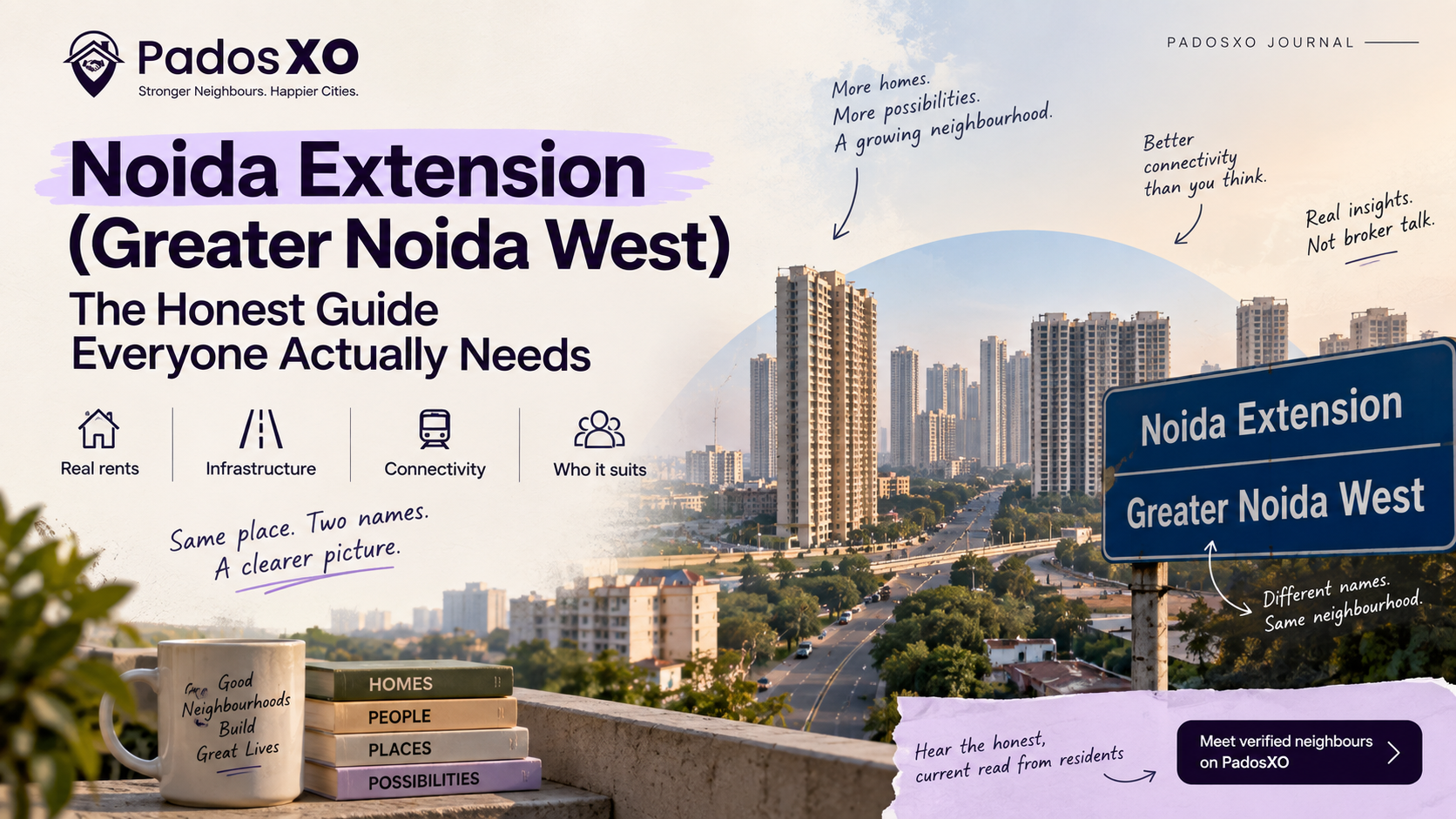
This is worth clearing up first, because it genuinely confuses newcomers and even trips up some listings: “Noida Extension” was the original, colloquial name used when this belt first developed as an overflow zone bridging Noida and Greater Noida. “Greater Noida West” is the more accurate, current administrative name, since the area actually falls under Greater Noida Authority jurisdiction, not Noida Authority. In practice, everyone — residents, brokers, delivery apps — uses both names interchangeably, so searching or asking about either one will surface the same place. See what's already live across Noida Extension and neighbouring sectors on PadosXO's Noida page.
What actually changed here in recent years
Noida Extension earned a rough reputation in its earliest years — delayed possessions, patchy infrastructure, construction dust everywhere. A meaningful share of that has genuinely improved: many of the originally delayed towers are now fully occupied and settled, road connectivity toward both Noida and Greater Noida has firmed up, and the retail and everyday-essentials infrastructure (markets, schools, clinics) has caught up considerably compared to five or six years ago. What hasn't fully caught up everywhere is metro connectivity — coverage is improving but remains less comprehensive than central Noida's, and some pockets are still adjacent to ongoing construction, which is worth checking street-by-street rather than assuming for the whole belt.
|
Factor |
Noida Extension / Greater Noida West |
|
2BHK rent (indicative) |
₹14,000–₹22,000/month |
|
Cost per sq ft (buying) |
Lowest in the wider Noida belt |
|
Metro access |
Improving, but less comprehensive than central Noida |
|
Housing stock |
Large-format high-rise apartment complexes, mostly newer construction |
|
Best suited for |
Budget-first renters and buyers willing to trade some connectivity for space and price |
Who this belt genuinely suits
Noida Extension makes the most sense for anyone for whom rent or purchase price per square foot is the dominant factor — you get meaningfully more space here than an equivalent budget buys in central Noida or Gurgaon. It also suits residents who work from home or commute primarily by car rather than depending on the metro for a daily office run, since road-based commute times to central Noida remain longer than sectors directly on the Expressway. Where it suits people less well is if metro-first, zero-compromise connectivity is the top priority — that's a stronger case for Sector 137 or a sector directly on the Expressway.
How this plays out in real life
Ankit and his wife, both working hybrid schedules with only two office days a week, moved to Greater Noida West specifically because it let them afford a 3BHK on a budget that would have meant a cramped 2BHK anywhere closer to central Noida. The trade-off they'd braced for — a rougher, half-finished neighbourhood — turned out to be milder than expected; their specific sector had matured well past its rocky early years, though two streets over, a resident they later connected with was still dealing with an active construction site outside her window. That gap between two addresses a few minutes apart is exactly why a single blanket verdict on “Noida Extension” is so often misleading — the honest answer always depends on the specific sector and even the specific tower, not the belt as a whole. For how Noida Extension's value proposition compares on cost alone, see our 2026 cost-of-living guide.
That's precisely the kind of street-level, current information a locality guide can only gesture at and a verified resident can actually confirm. Before committing to a specific sector within Greater Noida West, hearing from people already living in that exact pocket — via a verified neighbourhood app like PadosXO — is the fastest way to separate the settled streets from the still-developing ones.
A practical checklist before you commit
- Ask current residents about actual water supply reliability in that specific tower, not just the sector
- Confirm DG backup hours and per-unit charges — these vary considerably society to society
- Check how far the nearest functioning metro station actually is by walk time, not straight-line distance
- Visit on a weekday evening as well as a weekend — traffic and noise patterns differ noticeably
- Ask whether any construction is currently active on the immediate street, not just the broader sector
Renting vs buying in Noida Extension
For renters, Noida Extension's large-format apartments mean genuinely more space for the money than almost anywhere else in the wider NCR — a real 3BHK budget stretches further here than in central Noida or Gurgaon. For buyers, the belt's earlier possession delays mean it's worth extra diligence on a specific project's completion status, RERA registration and builder track record before committing, even though the majority of towers here are now fully built and occupied. The value proposition is real, but it rewards a buyer who does the homework rather than one who assumes the whole belt is uniform. For a more central Noida sector, see our Sector 137 locality guide.
How Noida Extension compares with central Noida sectors
Against a central Noida sector like 137, Noida Extension typically offers 20-35% more space for the same rent, at the cost of a commute that runs meaningfully longer and less metro-dependent. Against Sector 150, the comparison is closer — both offer more space than the densest central sectors — but Sector 150 retains stronger metro access and a more established retail ecosystem, while Noida Extension wins clearly on raw affordability. The honest framing: Noida Extension is Noida's value frontier, not its compromise option — for the right buyer or renter, it's a genuinely rational trade, not a fallback.
What long-term residents say changed the most
Residents who've been in the belt for five or more years consistently point to two changes: the retail and everyday-essentials infrastructure went from sparse to genuinely adequate, and the sense of the area being permanently "under construction" has faded in most, though not all, pockets. What they also flag honestly is that this maturity is uneven — a five-minute walk in one direction from a fully settled society can still lead to an active construction zone, which is exactly why a sector-wide verdict is less useful here than in most other NCR localities, and why talking to someone in your exact target society matters more in Noida Extension than almost anywhere else covered in this guide.
Before You Move, Ask Your Neighbours
Considering a move to Noida Extension or Greater Noida West? Get the honest, current read from verified residents in your specific sector. Download PadosXO free on the Play Store and connect with real neighbours before you commit.
Frequently asked questions
Is Noida Extension the same as Greater Noida West?
Yes — they refer to the same belt of sectors. Greater Noida West is the more formal, currently accurate administrative name (it falls under Greater Noida Authority), while Noida Extension is the older, still widely used colloquial name.
Is Noida Extension a good place to live now, in 2026?
It's improved substantially from its early reputation — infrastructure, occupancy and retail access have matured considerably. It remains the most budget-friendly entry point into the Noida belt, though metro connectivity still trails central Noida, and quality varies noticeably by specific sector and tower.
What is the rent for a 2BHK in Noida Extension?
Indicatively, ₹14,000–₹22,000 a month as of 2026, making it one of the more affordable options in the wider Noida-Greater Noida corridor.
Is Noida Extension well connected by metro?
Metro coverage has expanded but remains less comprehensive than central Noida sectors like 137 — many residents still rely more heavily on road transport, which is worth factoring in if you don't own a vehicle.
Why is Noida Extension cheaper than the rest of Noida?
Primarily because it developed later, sits further from Noida's established commercial core, and had a rockier early reputation around delayed possessions — both of which kept per-square-foot prices lower even as the actual infrastructure has caught up considerably.
Is it safe to buy or rent in Noida Extension today?
Broadly yes for well-established, fully occupied towers, though it's genuinely worth verifying the specific sector and building's current state — some pockets remain closer to ongoing construction than others, which a locality-wide summary can't capture.
How far is Noida Extension from central Noida?
Road distance to central Noida sectors is generally 20–35 minutes depending on traffic and the exact starting sector, longer than a comparable trip from Sector 137, given Noida Extension's position further from the core.
Is Noida Extension a good option for first-time home buyers?
It's one of the more accessible entry points into the NCR property market on a moderate budget, offering more space per rupee than central Noida or Gurgaon — worth pairing with careful project-level due diligence given the belt's history of possession delays.
What should I ask current residents before renting in Noida Extension?
Ask specifically about water supply reliability, DG backup charges, actual walk-time to the nearest metro, and whether any construction is currently active on the immediate street — these vary more within Noida Extension than in most other NCR localities.