
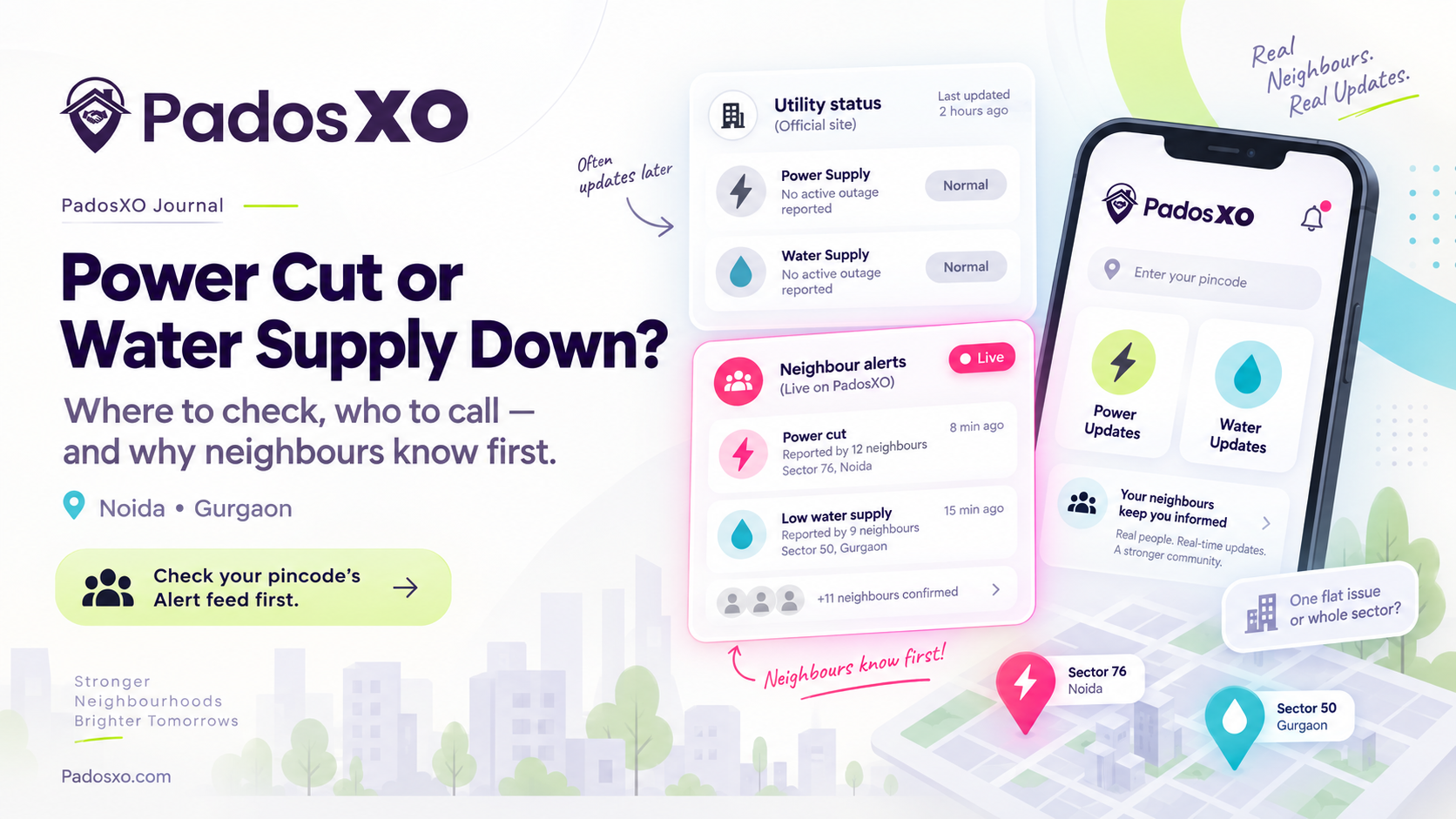
The first question when the lights go out isn't 'who do I call' — it's 'is this just me.' Anyone searching a power cut in Noida today, or the same question for Gurgaon, is really asking that. A tripped MCB in your own flat and a transformer fault down the street look identical from your living room. Before you call an electrician or start troubleshooting your own wiring, the fastest signal is whether anyone else on your street has the same problem right now — and getting that answer quickly saves both an unnecessary service call and the frustration of sitting in the dark wondering whether to act or just wait it out.
How to check a power cut in Noida today (or Gurgaon)
Noida's power comes through PVVNL (Paschimanchal Vidyut Vitran Nigam); planned and unplanned outages are occasionally posted on their portal or announced via SMS to registered numbers, though real-time sector-level status isn't always current. Gurgaon runs on DHBVN (Dakshin Haryana Bijli Vitran Nigam), which similarly logs complaints and outages but isn't built for instant per-sector lookup. Delhi, for comparison, splits power supply across three discoms — BSES Rajdhani, BSES Yamuna and Tata Power Delhi Distribution Limited — depending on which part of the city you're in, which adds an extra step of first confirming which discom actually serves your address before you know where to even check.
In practice, both utilities log a fault after it's reported better than they tell you proactively whether your sector is affected — exactly where a neighbourhood feed beats the utility's own website.
Checking water supply status
Noida's water supply runs through Jal Sansthan under the Authority; Gurgaon's is split between GMDA (bulk supply and major pipelines) and, in HSVP sectors, the Haryana Shehri Vikas Pradhikaran. Low pressure or a full outage can be a burst main, a scheduled maintenance window, or — more often than either — your own tank's motor or float valve. Ruling out 'is it just my building' before calling a plumber saves a wasted service visit.
Why a neighbour's Alert beats the utility website
Utility outage pages update on their own schedule, often after the fault is already fixed. A neighbour whose lights also just went out posts within minutes, and because PadosXO's feed is pincode-anchored, you're seeing reports specifically from your own 10 km radius — not a citywide feed diluted with sectors nowhere near you.
This matters most for exactly the judgment call above: is it worth calling an electrician tonight, or is half the sector already reporting the same outage and it'll likely resolve on its own within the hour.
|
Situation |
Utility website |
Neighbourhood Alert feed |
|---|---|---|
|
Speed of confirmation |
Often lags the actual event |
Live, as soon as a neighbour posts |
|
Scope |
City or discom-wide |
Your specific pincode/sector |
|
Useful for |
Filing a formal complaint |
Deciding whether to call a technician right now |
What to do if it's confirmed sector-wide
Once a few neighbours confirm the same outage, filing one complaint with the ticket number shared in the thread is more useful than everyone calling the helpline separately — it reduces the noise the discom's call centre has to sort through, and gives you a shared reference to follow up on.
When it turns out to be your own building, not the sector
Sometimes the Alert feed shows nobody else reporting the same problem, which is itself a useful (if less convenient) answer — it means the fault is local to your building or flat, not the grid. For power, that usually means checking your own MCB or the building's shared meter room before assuming a discom fault. For water, it's worth checking whether it's specifically your floor (a common issue in taller buildings during peak-usage hours, when pressure drops higher up first) versus the whole building, since that changes whether the fix is a plumber, the housing society's pump, or genuinely GMDA/Jal Sansthan's problem upstream.
Planning around scheduled maintenance windows
Both power and water utilities occasionally run planned maintenance, announced in advance rather than an unplanned fault — but often as a printed notice on a noticeboard or a one-line SMS, easy to miss. A pincode-level Alert or News feed helps here too: if a neighbour spots an official maintenance notice, sharing it means the rest of the sector isn't caught off guard when the power or water goes off as scheduled, instead of assuming a fault and calling to complain about planned work.
What actually helps during a longer outage
For outages expected to run beyond an hour or two, the practical questions shift from 'when will it be fixed' to 'how do I manage until then' — and this is another place a neighbourhood feed does something a utility website simply doesn't: neighbours sharing whether a specific nearby shop has a generator running, whether the society's backup diesel generator (where one exists) is covering common areas but not individual flats, or a simple heads-up that a particular ATM or shop is unaffected because it's on a different feeder line. None of this is official utility information, but all of it is genuinely useful in the moment, and it only exists because people nearby are willing to share it in real time.
How this plays out in real life
During a July heatwave, a Sector 137 Noida resident's power went out mid-afternoon. Before calling an electrician, she checked the Alert feed and found three neighbours had posted the same outage in the previous twenty minutes, one with a PVVNL complaint number already filed. She added her flat number to the same thread instead of filing a duplicate complaint, and power was restored two hours later — the same time it would have taken regardless, but without an unnecessary electrician visit or a duplicate ticket clogging the queue. A few weeks later, the same feed proved useful in reverse: a neighbour spotted a printed maintenance notice in their building lobby about a scheduled water shutdown for pipeline work and posted it, giving the rest of the sector two days' warning instead of the usual scramble when the taps unexpectedly ran dry.
Key takeaways
- Noida power: PVVNL. Noida water: Jal Sansthan (Noida Authority)
- Gurgaon power: DHBVN. Gurgaon water: GMDA or HSVP depending on sector
- Utility outage pages update with a lag; a pincode-anchored Alert feed updates in real time
- Confirming it's sector-wide (not your flat) before calling a technician saves a wasted visit
- If nobody else reports the same issue, the fault is likely local — check your own MCB, meter room, or floor-level water pressure
- Sharing a scheduled maintenance notice you've seen helps the rest of the sector avoid assuming a fault
- Once confirmed, share one complaint ticket in the thread rather than everyone filing separately
FAQ
Which company handles power supply in Noida?
PVVNL (Paschimanchal Vidyut Vitran Nigam) is the discom for Noida.
Which company handles power supply in Gurgaon?
DHBVN (Dakshin Haryana Bijli Vitran Nigam).
How do I know if a power cut is just my flat or the whole sector?
Check if neighbours nearby are reporting the same issue — a pincode-level Alert feed usually confirms this faster than the utility's own outage page.
Who handles water supply issues in Noida?
Jal Sansthan, under Noida Authority.
Who handles water supply in Gurgaon?
GMDA for bulk supply and major lines; HSVP in some sectors.
Should I call an electrician if the power is out?
Only after confirming it isn't a sector-wide discom issue — if neighbours report the same outage, it's a grid fault, not your wiring.
How fast do outage complaints usually get resolved?
It varies by cause — a local fault can be hours, while transformer or main-line issues can take longer. There's no fixed published SLA for either discom.
Why does water pressure sometimes drop only on higher floors?
During peak-usage hours, pressure loss often hits upper floors first in taller buildings — this is usually a building pump or plumbing issue rather than a utility-wide fault.
How do I find out about scheduled power or water maintenance in advance?
Notices are often posted physically in building lobbies or sent as a brief SMS and easy to miss — a neighbourhood feed where someone shares the notice gives the rest of the sector advance warning.
Is it worth filing a complaint even if it's a known sector-wide outage?
Generally yes, at least one complaint with a ticket number — this creates an official record, even if you coordinate with neighbours to avoid everyone filing separately.
What's the fastest way to confirm an outage isn't just my building?
Checking whether neighbours in the same pincode are reporting the identical issue at the same time is usually faster than waiting for the discom's own outage page to update.
Is there a complaint number for a power cut in Noida or Gurgaon?
Yes — PVVNL and DHBVN both take complaint calls, but neither publishes a live per-sector outage map, so a shared complaint number in a neighbourhood thread is more useful than the number alone.
📍 See What’s Happening Nearby
Before you call an electrician or a plumber, check what your street already knows. Open your pincode's Alert feed on PadosXO and find out in seconds whether it's just your flat — or the whole sector.