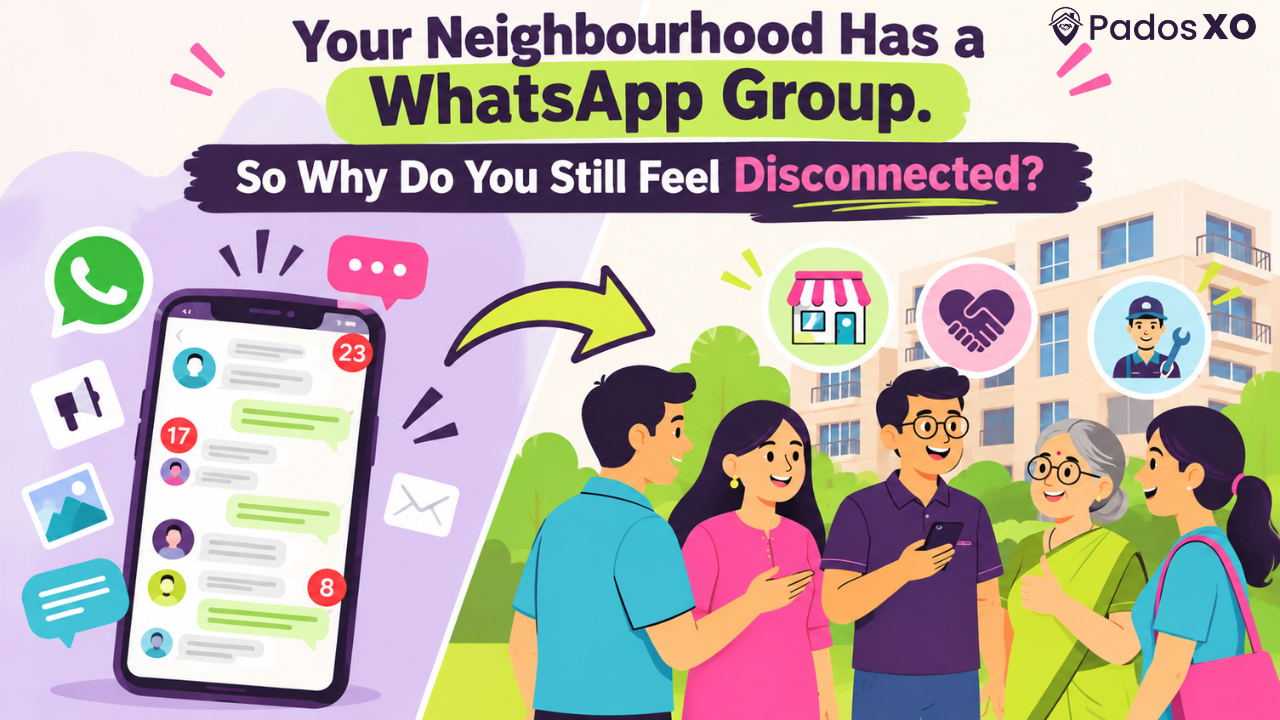
You live among hundreds of people. You have a neighbourhood group. You receive updates every day. Yet finding one useful recommendation from someone nearby can still feel like detective work.
Maybe the problem isn't that your neighbourhood doesn't communicate. Maybe it's that communication and community are two different things.
Being in a Group Isn't the Same as Knowing Your Neighbours
Think about the last time you needed something locally.
Perhaps you were looking for a reliable electrician. Maybe you wanted to know which grocery shop delivers after 10 PM. Or you wanted to sell an old study table without dealing with buyers from across the city. You probably had one thought:
"Someone around here must know."
And you would probably be right.
The challenge is finding that person.
A neighbourhood WhatsApp group is useful for quick communication. It can help residents share urgent announcements, coordinate society matters and circulate information. But as a group becomes larger, everyday conversations can become difficult to follow. Important recommendations get buried. Questions get repeated. Useful information disappears into the chat history.
And not everyone wants to participate in a group where every message is visible to everyone. The result? People may be connected digitally without becoming meaningfully connected locally.
A Neighbourhood Is Full of People You Haven't Met Yet
Imagine a residential sector in Noida. On one floor, a family has lived there for eight years. They know the most reliable electrician in the area. Two streets away, a woman runs a home-based tiffin service. She has regular customers but doesn't know that several working professionals nearby are looking for home-cooked meals. A college student in the same neighbourhood wants a part-time job. A retired teacher is willing to tutor schoolchildren. A family moving into the area wants recommendations for a good paediatrician.
These people have something in common: they are looking for connections that already exist around them. But without a way to discover one another, they may continue searching outside their neighbourhood. That's a missed opportunity for everyone. A useful neighbourhood network should make these local connections easier to discover.
What a Neighbourhood Community Actually Needs
A good community isn't measured by how many messages it sends. It's measured by whether people can find help, share useful information and participate when something matters.
Here are five things that make a neighbourhood network more useful.
1. Useful Information Shouldn't Disappear
Suppose a resident asks:
"Can anyone recommend a good AC repair person in Sector 62?"
Three people reply with recommendations. Someone shares a phone number. Another resident mentions a bad experience with a different provider. That's useful information.
But if someone asks the same question two weeks later, the entire conversation may have to happen again. Local recommendations should be easier to discover, revisit, and share. A neighbourhood should not have to start from zero every time someone needs a service.
2. People Should Be Able to Find Each Other Beyond Their Apartment
Not every community is limited to one housing society. Someone living in a rented flat may want to connect with nearby residents. A shop owner may want to reach customers in surrounding streets. A student may be looking for a local tutor or part-time opportunity.
Useful neighbourhood connections often extend beyond the building gate. That's why locality and pincode-based discovery can be valuable. It helps people explore what's happening around their homes, not just inside their residential complex.
3. Trust Should Have a Place in Local Discovery
Would you rather take a recommendation from an anonymous account or hear from someone whose local presence can be verified? For neighbourhood platforms, this distinction matters. Verification can provide an additional signal about whether someone is genuinely connected to the area. But it should not be confused with a guarantee that every recommendation, service provider or transaction is safe. People should still use their judgement, check credentials where necessary and take normal precautions.
4. Local Businesses Should Be Part of the Community
Think about the small businesses that keep a neighbourhood running. The tailor who alters clothes in two hours. The home baker who takes weekend orders. The electrician who responds when the power trips. The small salon that residents recommend to one another.
These businesses often depend on local customers and word of mouth. A useful neighbourhood network should give residents a way to discover nearby businesses and give local entrepreneurs a way to reach people around them.
5. Residents Should Have a Way to Participate
A neighbourhood isn't just a place where people sleep and leave for work. Residents may want to discuss a broken streetlight, share a local event, find someone to exchange books with, offer help during an emergency or sell something they no longer need.
These conversations are part of everyday community life. A neighbourhood platform should make room for different kinds of participation, rather than limiting everything to announcements and complaints.
Try This: Five Questions That Can Make You Feel More Connected to Your Neighbourhood
You don't need to organise a large community event or know everyone in your building. Start with something small.
1. Who is the most reliable electrician or plumber nearby?
Ask someone who has actually used their services.
2. Is there a local business worth discovering?
It could be a home kitchen, a tailor, a stationery shop or a neighbourhood salon.
3. Are there people nearby who share your interests?
You might find someone who plays badminton, cycles on weekends, reads the same books or wants to learn a new skill.
4. What is one recurring problem in your area?
It could be poor street lighting, irregular waste collection, parking issues or a damaged footpath. Find out whether others have noticed it too.
5. Is there something you can offer your neighbours?
Perhaps you can tutor a child, recommend a good service provider, share unused furniture or help a new resident settle in.
The point isn't to turn every interaction into a networking opportunity. It's to make local life a little easier for one another.
The Difference Between a Chat Group and a Neighbourhood Network
A chat group is primarily built around messages. A neighbourhood network should be built around people, places and useful local information.
|
A typical group conversation |
A useful neighbourhood network |
|
A recommendation gets buried in the chat |
Recommendations are easier to discover |
|
Residents mostly interact through messages |
Residents can discover people and businesses nearby |
|
Information is often repeated |
Local information can remain useful beyond one conversation |
|
Communication may be limited to one society |
Connections can extend across a neighbourhood |
|
Participation depends on being active in the group |
People can explore relevant local information when they need it |
This doesn't mean WhatsApp groups are useless. They are excellent for quick conversations and coordination. But they don't have to be the only way a neighbourhood connects.
Can Technology Bring Back the Neighbourhood Feeling?
Technology cannot force people to become friends. It cannot guarantee that every neighbour will be helpful or that every local recommendation will be reliable. But it can remove some of the friction that prevents people from connecting. A platform that helps residents discover nearby people, local businesses, recommendations, events and community updates can make it easier to participate in everyday neighbourhood life.
That's the idea behind PadosXO.
Built around your pincode, PadosXO helps residents discover verified neighbours, share local updates, find recommendations, explore nearby services and connect with people in their area. You don't need to wait for a society committee or RWA to start a neighbourhood conversation. Because a neighbourhood shouldn't become a community only when something goes wrong.
Your Neighbourhood Is More Than the Place You Return to Every Evening
The next time your kitchen tap leaks, you might know exactly whom to call. The next time a new family moves in, you might be the person who tells them where to find the nearest grocery shop. And the next time someone nearby needs a tutor, a second-hand table or a recommendation for a reliable service provider, you might have the answer. You don't need to know everyone who lives around you. But it helps to know that there are people nearby you can turn to.
A neighbourhood becomes more useful when the people living in it become easier to find. Discover your neighbourhood on PadosXO.
Frequently Asked Questions
1. Is a neighbourhood WhatsApp group enough to build a community?
A WhatsApp group can help residents communicate and share announcements. However, building a neighbourhood community also involves discovering local people, services, recommendations, events and opportunities beyond group conversations.
2. How can I get to know my neighbours?
Start with small interactions. Ask for local recommendations, participate in community activities, introduce yourself to nearby residents and offer help when possible. You can also use neighbourhood platforms to discover people and local updates.
3. What is a neighbourhood community platform?
A neighbourhood community platform connects people based on where they live. It can help residents share local updates, find nearby services, exchange recommendations, discover events and interact with people in their area.
4. Can I connect with neighbours outside my housing society?
Yes. Neighbourhood-based platforms can connect residents across nearby streets, colonies and residential societies, depending on their geographic coverage.
5. Why are local recommendations useful?
Local recommendations can help residents discover service providers, shops and businesses that people nearby have actually used. They offer additional context beyond a generic online search, although individual experiences can differ.