Cost of living in Delhi is one of those searches that return a single average number, which is almost useless in a city this varied — a flat in South Delhi and a flat in Outer Delhi can differ by tens of thousands of rupees a month while both technically sit inside "Delhi."
This guide breaks the real cost of living down by area and by life stage, rather than pretending one number tells the whole story.
Why “cost of living in Delhi” has no single answer
Delhi is less one city than a patchwork of very differently priced pockets — a 1BHK in Vasant Kunj and a 1BHK in Rohini can differ by ₹20,000 or more in rent alone, despite both technically being “Delhi.” Any single average figure for the whole city is therefore only a starting point; the honest answer to “what does it cost to live in Delhi” depends heavily on which part of Delhi, which is exactly why this guide breaks the budget down by area rather than offering one number and stopping there.
|
Area type |
1BHK rent (indicative) |
Overall cost tier |
|
South Delhi (Saket, GK, Vasant Kunj) |
₹25,000–₹45,000 |
Premium |
|
Central Delhi (CP-adjacent, Karol Bagh) |
₹20,000–₹35,000 |
Moderate-high |
|
West Delhi (Rajouri Garden, Janakpuri) |
₹15,000–₹25,000 |
Moderate |
|
East Delhi (Mayur Vihar, Preet Vihar) |
₹13,000–₹22,000 |
Moderate-affordable |
|
Outer / North Delhi (Rohini, Dwarka) |
₹10,000–₹18,000 |
Affordable |
A realistic monthly budget, line by line
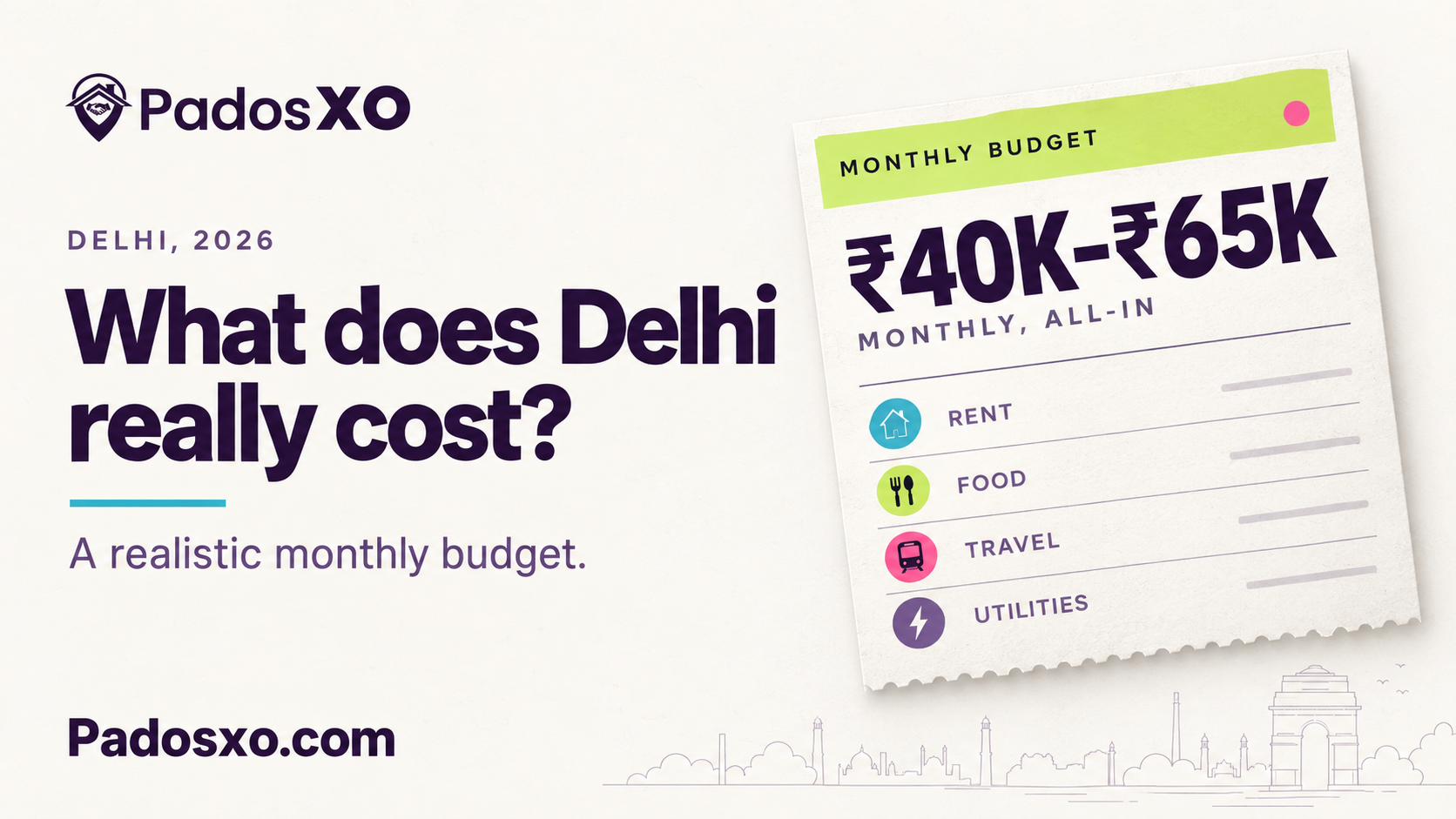
Beyond rent, here's an indicative monthly breakdown for a single working professional in a moderate Delhi neighbourhood. Utilities and internet typically run ₹2,500–4,500, factoring in Delhi's genuinely high summer electricity bills from continuous air conditioning use. Groceries and household essentials for one person run ₹6,000–10,000. Transport — a mix of metro and cabs — runs ₹3,000–6,000 depending on commute distance and how much of it is metro-covered versus cab-dependent. Part-time house help (cleaning, occasional cooking) adds ₹3,000–6,000 if you choose to hire.
Add discretionary spending — eating out, entertainment, the inevitable weekend expenses — and a realistic all-in figure for a single professional in a moderate area lands around ₹40,000–₹55,000 monthly, rent included, with South Delhi addresses pushing that meaningfully higher. See what's already live in your Delhi locality on PadosXO's Delhi page.
Delhi vs Gurgaon vs Noida: the honest comparison
For anyone deciding between the three, the pattern is fairly consistent: Gurgaon tends to run highest for comparable corporate-adjacent housing, reflecting its concentration of MNC offices and premium new-build stock. Delhi's cost varies the most internally of the three, spanning from genuinely premium South Delhi addresses to considerably more affordable Outer Delhi options within the same city. Noida generally sits below Gurgaon for a comparable flat and offers more predictable, planned infrastructure, making it the most consistently mid-range of the three for a similar quality of housing. None of this means one city is simply “cheaper” — it means the right comparison has to specify which neighbourhood in each city, not the city name alone.
Where the real savings are — and aren't
The single biggest lever on your Delhi cost of living is area choice, not lifestyle austerity — someone in Rohini living comfortably can easily spend less overall than someone in South Delhi living frugally, simply because the rent gap dwarfs most discretionary-spending differences. The second biggest lever is sharing accommodation: splitting a 2BHK or 3BHK with flatmates in Delhi cuts per-head housing cost dramatically and is extremely common among young professionals for exactly this reason. Where people often overspend without realising it is transport — defaulting to cabs for a commute the metro covers reasonably well can quietly add ₹3,000-5,000 a month that a slightly less convenient but metro-based routine would save.
A worked example: two professionals, two very different budgets
Consider two people earning similar salaries. One rents a 1BHK alone in Vasant Kunj, takes cabs to work daily, and eats out often — their realistic monthly spend lands close to ₹70,000-80,000 once everything is added up. The other shares a 3BHK with two flatmates in Mayur Vihar, relies on the metro for most of their commute, and cooks most meals at home — their comparable monthly spend can come in closer to ₹35,000-40,000, despite living in the same broad city with a similar lifestyle otherwise. The gap isn't about one person being more frugal; it's almost entirely about area and living-arrangement choices made upfront. For the Gurgaon-specific version of this same budget breakdown, see our moving-to-Gurgaon guide.
Whatever budget or area you're weighing, published averages only get you so far — actual current rents, maintenance charges and hidden costs like DG backup billing vary block by block and change faster than any published guide can track. Verified residents already living in your shortlisted area, reachable through a neighbourhood app like PadosXO, can confirm today's real numbers before you commit to a lease.
Hidden costs that rarely make it into a budget
A few recurring costs surprise newcomers specifically because they're easy to miss when comparing listed rents. Society maintenance in better-managed South and Central Delhi complexes can add ₹2,000–5,000 monthly on top of rent, often not clearly flagged in the initial listing. DG backup and inverter-related charges vary widely from society to society and are almost never mentioned until you're already discussing a specific flat. And Delhi's air quality through winter months pushes many households toward air purifiers, which carry both an upfront cost and an ongoing filter-replacement and electricity cost worth factoring into a genuinely realistic annual budget, even though it's easy to overlook when planning month to month.
Seasonal cost swings worth planning for
Delhi's cost of living isn't flat across the year the way a monthly average implies. Summer (April–June) electricity bills from near-constant air conditioning can run 40-60% above winter levels in the same flat. Winter brings its own costs — heating in the coldest weeks, and for many households, air purifier running costs during the worst pollution stretches. Festive months (October-November) bring a predictable bump in discretionary spending across nearly every household. Budgeting a genuinely flat monthly figure year-round tends to underestimate April-June and October-November specifically, and a small buffer for both is worth building in from the start rather than being surprised by it every year. For the Noida-specific version, see our sector-by-sector guide to Noida.
Delhi cost of living by life stage
A single young professional sharing accommodation can realistically live well on ₹30,000-40,000 monthly in a moderate area. A couple without children, renting a 1-2BHK independently, should budget ₹55,000-75,000 depending on area. A family with school-age children adds school fees — which vary enormously, from moderate in government-aided or lower-fee private schools to very high in South Delhi's premium institutions — on top of a larger flat's higher rent, easily pushing a comfortable family budget past ₹90,000-120,000 monthly in a mid-to-premium area. None of these figures are prescriptive; they're a realistic starting range to sanity-check your own plan against.
Cost of living in specific South Delhi pockets
A few South Delhi localities get searched often enough on their own that they're worth calling out individually rather than folding into a single "South Delhi" average. Cost of living in Gulmohar Park — one of South Delhi's quieter, greener addresses — runs toward the upper end of the South Delhi range given its low density and leafy, low-rise character. Cost of living in Defence Colony sits similarly premium, reflecting its central location and established infrastructure. Cost of living in Panchsheel Enclave and the South Extension 1 area both land in a comparable premium band, with South Extension carrying a modest edge for its market and metro access. In all four, the rent gap versus East or Outer Delhi is the dominant cost driver — everything else in a monthly budget moves far less between neighbourhoods than rent does.
Before You Move, Ask the People Who Live There
Planning a move within Delhi or from another city? Get real, current cost checks from verified residents in your target area before you commit. Download PadosXO free on the Play Store and connect with real neighbours.
Frequently asked questions
What is a good monthly salary to live comfortably in Delhi?
For a single professional, ₹60,000–₹80,000 a month generally allows comfortable living in a moderate Delhi area with some savings; South Delhi's premium addresses realistically need a higher income for the same comfort level.
Is Delhi cheaper than Gurgaon?
Generally, yes for comparable housing — Delhi's cost varies widely by area, but its more affordable pockets (East and Outer Delhi) tend to undercut Gurgaon's corporate-adjacent rents, while South Delhi's premium areas can match or exceed them.
What is the average rent for a 1BHK in Delhi?
Indicatively, ₹10,000–₹45,000 a month as of 2026, varying enormously by area — Outer Delhi sits at the lower end, South and Central Delhi at the upper end.
How much does it cost to live alone in Delhi?
A single professional living alone in a moderate area should realistically budget ₹40,000–₹55,000 a month all-in, including rent, utilities, groceries, transport, and occasional help — more in premium South Delhi areas, less if sharing accommodation.
Is public transport enough to get around Delhi, or do I need a car?
The Delhi Metro covers a large part of the city well and is genuinely usable as a primary commute method for many routes, though areas further from a metro line often require supplementing with autos, cabs, or a personal vehicle.
Which is more affordable — Delhi, Gurgaon or Noida?
It depends on the specific area within each city rather than the city as a whole — Noida tends to be the most consistently mid-range, Gurgaon the most consistently premium for corporate-adjacent housing, and Delhi spans the widest range from very affordable to very premium depending on the neighbourhood.
How much do utilities cost in Delhi?
Electricity and internet together typically run ₹2,500-4,500 a month for a single household, though summer air-conditioning use can push electricity bills 40-60% above winter levels in the same flat.
Is it cheaper to live in East Delhi or South Delhi?
East Delhi (areas like Mayur Vihar and Preet Vihar) is generally meaningfully more affordable than South Delhi (Saket, GK, Vasant Kunj), often by ₹10,000-20,000 a month for comparable flat sizes.
Does Delhi's cost of living include school fees for families?
The figures above cover a general adult household budget; school fees are a separate, highly variable line item that can range from modest in government-aided schools to very significant in premium South Delhi private schools, and should be budgeted separately by families.